Search results for: “bram stoker”

  • Henry Irving & Bram Stoker: A Working Relationship by Michael Kilgarriff

    Henry Irving & Bram Stoker: A Working Relationship by Michael Kilgarriff

    Henry Irving and Bram Stoker enjoyed a relationship which patently worked. Irving provided the star power and the driving force, Bram a bottomless well of loyalty and the administrative capability to keep the show on the road. Their comradeship was without friction or rancour and they remained on good terms for twenty-seven years until that final chilly night in Bradford. So let’s take a look at the two men, and see where and how they merged and converged.

    HI was remote, sardonic, presenting a carapace of thespian gravitas. Bram was gregarious, genial, the ideal Front-of-House meeter and greeter. Some said that HI did not treat Bram well, that he could be offensive and even derisive towards his lieutenant. I find this unlikely. Bram was a sensitive, emotional soul who would not have lasted the course if he’d felt undervalued or disrespected. True, theirs was not an equal partnership for HI was unquestionably the Guv’nor, but together they made a matchless team.

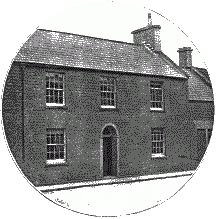
    Henry Irving was born John Brodribb on 6 February, 1838, in Keinton Mandeville, a Somerset village as unexceptional then as it is now. His father’s occupation is unknown – shopkeeper? traveller in menswear? – but we do know he lived frugally with his wife and son in two small rooms. While still a toddler Johnnie’s parents moved to Bristol, but he was sent for his health’s sake to live with his Aunt Sarah and family in Halsetown, Cornwall. Just imagine the despair of separation. ‘At first I was miserable enough; I parted from my mother as though my heart was breaking, but did not show half I felt, nor she either.’(1)

    Yet another trauma lay in wait for the boy six years later: re-joining his parents in the City of London where his father had obtained employment, the nature of which also remains undetected. Again young Johnnie suffered bewildering disruption, this time exchanging the fresh open Cornish landscape for the smoky, alarming streets of the Metropolis. No wonder the gawky only child developed a speech defect.

    Bram Stoker’s origins were altogether more genteel and settled. He was born in Clontarf, Dublin, on 8 November 1847, the third of seven children in a solidly respectable, middle-class Protestant family. His father was Senior Clerk in the Dublin Court of Petty Sessions and three of his brothers became doctors, one achieving eminence as President of the Royal College of Surgeons in Ireland and a baronet to boot. But from his earliest years Bram suffered a mysterious ailment which prevented him from walking properly until he was seven, though by his teens he evinced no physical disabilities whatsoever. Quite the reverse, as we shall see.

    Irving also seems to have suffered a childhood accident which left him with a dragging leg. To conquer the handicaps of gait and diction well enough to become recognised as the greatest actor of the age shows a transcendental strength of purpose, but the future Elevator of the Stage had to overcome a further impediment to his ambitions: Methodism. To assuage the family shame at his
    choice of career John Brodribb chose the stage name of Henry Irving, Henry having been added to John at his christening and Irving perhaps after Washington Irving, an author he admired, or perhaps Edward Irving, a preacher who had himself briefly trodden the boards.

    His very first professional engagement, at Sunderland in 1856, nearly ended in ignominious dismissal, when failure to study his lines on a Sunday resulted in a catastrophically ill-prepared Monday performance. The Sabbath, divinely ordained day of rest or not, was never again allowed to interfere with what he was to call ‘the work’; the ‘God Blesses’ with which his letters and farewells were sprinkled we can take as casual expressions of friendship, not full-blown benedictions. His occasional church-going was also, in my judgment, prompted by convention rather than conviction, for as we learn from Isabel Bateman, his first Lyceum leading lady who was eventually to abandon the stage for the cloister, ‘The man she loved was not a believer’.(2)

    One notable similarity between HI and Bram was their height, for both were well above the 1870 average of 5ft 7ins. On the one occasion I met Laurence Irving, son of H B Irving, he told me that his grandfather’s court dress fitted him perfectly, and that he, Laurence, was 6′ 2″. In a letter to Walt Whitman written in 1872 Bram also states himself to be ‘six foot two inches high and twelve stone weight naked’.(3)

    In this same letter Bram declared, ‘I am equal in temper and cool in disposition and have a large amount of self-control and am naturally secretive to the world.’ Such a temperament was to serve him well in his years of dealing with theatrical wheeler-dealers and rip-off suppliers on both sides of the Atlantic, though for ‘secretive’ I would read ‘tactful and discreet’. In contrast, according to Max Beerbohm, ‘Irving’s presence dominated even those who could not be enchanted by it. His magnetism was intense, and unceasing.’ (4)

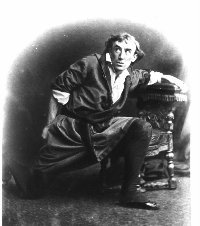
    Bram was full-bearded, HI clean-shaven, as were most actors of the period, leaving their faces a blank canvas on which to limn their characterisations. Bram’s hair was red and neatly trimmed, HI’s raven locks famously flowed. Bram never lost his light Dublin lilt; HI’s stage assumption of gentlemanly manners and speech were often remarked upon in reviews, so we can presume that he
    successfully camouflaged his humble upbringing.

    In 1864, at the age of sixteen, Bram entered Trinity College, Dublin, and in 1866 began his career in the Irish Civil Service. HI left school aged only thirteen, to work for a firm of solicitors and then for an East India merchant.

    Despite Bram’s crippling illness in his early childhood, as mentioned above, he grew into an exceptionally versatile sportsman, winning prizes for, amongst other disciplines, walking, hurdles, vaulting, high jump, and long jump. He was a keen oarsman and rugby player, and even became a notable performer on rings and trapeze. But he also fully exercised his intellect, reading for a science degree while involving himself in the running of the University Historical and Philosophical Societies. HI, on the other hand, confined his leisure activities to nothing more strenuous than the occasional day’s fishing.

    Nor was politics of much interest to the actor. Bram wrote that in 1880:

    ‘Those were early days in the Home Rule movement, and as I was a believer in it Irving was always chaffing me about it. It was not that he had any politics himself – certainly in a party sense; the nearest point to politics he ever got, so far as I know, was when he accepted his election to the Reform Club.’

    So while HI’s political beliefs remain shadowy we can posit a vague Liberalism – Gladstone, for instance, had his own personal seat in the Lyceum wings. How Irving voted, if he voted at all, we don’t know. Both he and Bram were Freemasons, though HI’s involvement in the Craft was largely confined to supporting its charities. Membership was expected of a successful man in late-Victorian England and it would have given offence in high places had he declined. But it took him six years to achieve the basic degree of Master Mason, for learning arcane rituals and dressing-up in his spare time can not have appealed. He did that for a living.

    * * *

    Bram’s first sighting of Henry Irving was as Captain Absolute in The Rivals at the Theatre Royal, Dublin, in 1867. Bram would have been only nineteen; a fourpage paean of praise in his Reminiscences written nearly forty years after the event smacks more of novelistic indulgence than a reliable memoir. He next saw HI in 1871, as Digby Grant in Two Roses. Again in his Reminiscences Bram treats us to three and a half pages of hagiographical flatulence, contradicting his original review in the Dublin Evening Mail which had been sharply critical.

    They finally met in 1876, when HI, now firmly established as Britain’s leading actor – though still an employee of Mrs Bateman – brought his much-lauded Hamlet to Dublin. Bram wrote a penetrating review in the Dublin Evening Mail and HI, never one to miss an opportunity to court the press, invited him to supper at the Shelbourne Hotel. Sensing easy prey, Irving invited Bram to dine again the following Sunday.

    Here the host obliged with his party piece: Thomas Hood’s Dream of Eugene Aram. It was to prove a life-changing experience for the Irishman. There are many contemporary accounts of HI’s electrifying delivery of the poem, and at the conclusion as Aram was led away ‘With gyves upon his wrist’ Bram suddenly exploded into violent hysterics, an unexpected but gratifying reaction for the performer. ‘Then began the close friendship between us,’ recalled Bram, ‘which only terminated with his life – if indeed friendship, like any other form of love, can ever terminate…From that hour began a friendship as profound, as close, as lasting as can be between two men.’

    At this time HI was laying plans to become his own master. Would Bram consider becoming his business manager? Bram, anxious to establish himself as a writer, agreed to respond when the call came, for London offered far richer literary opportunities than Dublin.

    Two years later, in 1878, Mrs Bateman bowed to the inevitable and made over the lease of the Lyceum to her cuckoo-in-the-nest star actor. Having at last assumed the purple HI engaged as his leading lady Ellen Terry, replacing the worthy but uncharismatic Isabel Bateman who had perforce to trudge up Rosebery Avenue where her mother had leased Sadler’s Wells. Spurned as a
    woman and as an actress, she learned the hard way that when it came to ‘the work’ Henry Irving was not just dedicated but ruthless.

    * * *

    December 1878, therefore, was a highly significant month for both men. On the 4th, a full year earlier than planned, Bram married Florence Balcombe, and ten days later he formally joined HI’s team at the Lyceum. What did the bride make of it all? I suspect she was as thrilled by the whirlwind of events as her new husband. She was an exceptionally pretty woman – Oscar Wilde was a
    disappointed suitor – and the opportunity of making a mark in London salons was seductive. Certainly Bram had no doubts. Throwing in his lot with HI was like a second marriage; it was scarcely less profound a commitment.

    Irving’s wife was also named Florence, but their life together was wretchedly unhappy. They had finally separated in 1871, though they never divorced – the risk of social obloquy was too great. Their sons, Harry Brodribb Irving and Laurence Irving (the latter named slightly inaccurately for HI’s bosom friend John Lawrence Toole) lived with their mother, a mean-minded woman totally unsuited to be an actor’s helpmeet.

    The Stokers had one child, a boy christened Irving after his godfather, though he was always known by his second name Noel. Their union survived intact until Bram’s death over thirty years later.
    Still in the momentous month of December, 1878, HI opened his eagerly anticipated first Lyceum season on the 30th with a revival of Hamlet. The acclaim was tumultuous, unprecedented in its fervour by press and public alike. The following day Bram also had cause to celebrate: the publication of The Duties of Clerks of Petty Sessions, a book whose text, I fancy, was not as lurid as
    his later fiction.

    Two months before Bram actually started working for HI he had received a letter which ended ‘With love, in great haste, Henry.’ The following week, writing from Sheffield, HI again signs off with ‘love’. But by August, 1879, less than a year later, HI was signing himself ‘Yours sincerely’. The reason for this apparent cooling must be ascribed to the change in Bram’s status, from personal friend to employee. HI was, after all, the Guv’nor.

    In the Lyceum programmes ‘Mr Henry Irving’ was always on the front page as Sole Lessee and Manager. Bram would be listed, on page three or four, well down the pecking order as Acting Manager, after the likes of H J Loveday (Stage Manager) and Meredith Ball (Musical Director). With no standing in the creative hierarchy Bram was perhaps lucky to be mentioned at all. Nevertheless he threw himself into his new duties, writing some fifty to sixty letters a day.

    The entire two volumes of his Reminiscences mention HI only in terms of reverential praise, the single instance of criticism is that he ‘could be secretive’, a word Bram had used to describe his own nature thirty-four years earlier. Bram may have possessed the less complex character, but his fictional oeuvre, which was to ripen in the 1890s, showed a darker and more ambivalent nature than his bluff, hail-fellow-well-met public persona would lead us to believe. His heroworship extended to florid panegyrics on the Guv’nor’s fitness and physique, noting that up to his sixtieth year HI was…

    ‘…compact of steel and whipcord. His energy and nervous power were such as only came from a great brain; and the muscular force of that lean, lithe body must have been extraordinary.’

    This does seem a touch over-wrought, but let me here and now stamp firmly on the notion that Bram was a closet gay. Nor should any unwarranted inference be drawn from the intimacy which HI famously enjoyed with J L Toole, a hugely popular comic actor who had been something of a mentor to Irving in his early career. Mrs Aria, HI’s companion of his later years, wrote:

    ‘To the last day of Irving’s life the friendship of the two men each for the other never flagged or faltered…Each had, in his own way and of its own kind, a great sense of humour. Toole’s genial, ebullient, pronounced; Irving’s saturnine, keen, and suggestive.’ (5)

    So did Bram ever really know HI? Or did he know only as much as HI wished to reveal? The artist and writer W Graham Robertson said ‘as an actor [HI] gave expression to everything; as himself he was careful to tell nothing’. Sir John Martin Harvey’s melancholy view was that HI was ‘the loneliest man he ever knew’. W L Courtney, critic, observed ‘In some undefined way, he conveyed the
    impression that he stood apart – that his personality moved in a sphere of its own’. Novelist Horace Annersley Vachell said much the same: ‘Irving…appeared to soar above himself into an empyrean remote from ordinary criticism.’ Part of Bram’s value may be seen therefore as a conduit between HI’s supra-worldliness and the mundanities of management. But his contribution to the Guv’nor’s success did not go unnoticed. Here’s the Chicago Daily News in 1888:

    ‘Mr Irving’s great success in this country has been due to a very considerable extent to the shrewd management of Bram Stoker. We know of no manager more vigilant, more indefatigable, more audacious than he. He knows how to make friends, how to keep them, and how to utilize them. At all times he has an eye to business, yet he is always to all apparences a careless, cordial man of the world. In the manipulation of Mr Irving’s intricate and enormous business he exhibits a coolness, a shrewdness, and an enthusiasm that are simply masterful…Irving is fortunate in having so able and so loyal an associate.’

    Fourteen years later Bram was still beavering away with undiminished vigour, leaving the Northern Echo to opine ‘One is led to wonder what Sir Henry would do without this Trojan whose ubiquity is astounding.’

    Despite meticulous stewardship of HI’s finances Bram was not so shrewd with his own. In the early 1890s he lost heavily in a continental publishing venture and in an investment scheme promoted by Mark Twain. So disastrous were these speculations that by 1896, despite an income of £22 per week, he was obliged to borrow £600 from the writer Hall Caine. (6)

    1896 was also catastrophic for Henry Irving. On 19 December, exhausted after a Lyceum opening night as Richard III, he slipped on the stairs at his Grafton Street apartments, badly injuring a knee. He was incapacitated for ten weeks, and the financial repercussions were dire. For several years the Lyceum had run at a loss, insolvency kept at bay only by regular and increasingly demanding tours of the UK and North America. The accident marked the beginning of a decline in the actor’s health and fortunes; the glory days were over.

    * * *

    For Irvingites the publication of Dracula is but a glancing incident. For Stokerites, however, this 1897 turgid tale of the Undead is the apex of their hero’s life’s work, with Henry Irving little more than a walk-on. To what extent the Count was based on HI is debatable. Both the actor and his alleged avatar were tall and compelling, and Bram’s entry in the Oxford Dictionary of National
    Biography makes a further interesting comparison:

    ‘Complex and highly symbolic, the plot illustrated his fears about a world approaching a new century, about male insecurity and the dangers of subservience to another person. Dracula was also a shape-shifter. Is an actor not also a shape-shifter?’

    Good point, but Paul Murray goes into overdrive with a racy run-down of the novel’s themes and subplots:

    ‘The powerful sexual charge which runs through Dracula has caught the attention of modern commentators, who see in it deviant and taboo forms of sexuality, including rape, incest, adultery, oral sex, group sex, sex during menstruation, bestiality, paedophilia, venereal disease and voyerism, among other things.’(7)

    What ‘other things’, I wonder? This thesaurus of carnality surely tells us more about Mr Murray than it does about Bram Stoker.

    Irving himself tapped into the rage for the supernatural with his colossally successful 1885 production of Faust, complete with devils, witches and red fire, but his opinion of Dracula after seeing a copyright reading was expressed in one word: ‘Dreadful!’ He would of course have been ideal casting for the sinister Count. The tall gaunt actor would also have been perfect as Sherlock Holmes,
    though alas he turned down Conan Doyle’s offer of a play.

    Perhaps Irving was wary of frock-coat parts, for the last of the Romantics had little sympathy for moderns like Ibsen, Chekhov, Gogol or Shaw. One must sympathise with the veteran actor/producer for his reluctance to move out of his comfort zone. We don’t castigate Elgar for not composing like Stravinsky or Sickert for not painting like Picasso, so let us admire Irving’s achievements for what they were and not berate him for what we think they should have been. His one essay at contemporary drama, The Medicine Man, produced in 1898, was a rank failure, to be withdrawn after twenty-four performances.

    For HI 1898 was an annus horrendus. In February fire destroyed £30,000 worth of scenery stored in a railway arch. In the ferocity of the flames HI lost almost his entire stock-in-trade – the only sets left were those in the Lyceum at the time. That he had recently reduced his insurance from £10,000 to £6,000, against Bram’s advice, did little to soften the blow. Worse was to come. In October while on tour HI was struck down with pleurisy and pneumonia; without the actor-knight topping the bill takings plunged. The onset of emphysema further depleted his energies.

    A significant newcomer to the Lyceum was Laurence Irving, HI’s actor dramatist younger son. His 1898 Peter the Great, despite providing his father with a suitably dominant role, failed to attract. Sardou’s Robespierre and Dante were also dated and hugely expensive to mount, but Laurence, who translated and adapted both pieces, had his father’s ear. Bram realised he was being sidelined.

    ‘In those last seven years of his life I was not able to see so much of him as I had been on the habit of doing throughout the previous twenty…my work became to save him all I could…But the opportunities were different. Seldom now were there the long meetings when occasion was full of chances for self-development, for self-illumination; when idea leads on
    idea till presently the secret chambers of the soul are made manifest….The man, wearied by long toil and more or less deprived by age and health of the spurs of ambition, shrank somewhat into himself.’

    The prose is flowery – what are ‘secret chambers of the soul’? – but Bram was obviously hurt by the withdrawal of the man to whom he had been so close for so long. Worse was to come in 1899 when, against Bram’s strongly expressed advice, HI relinquished his Lyceum lease to a limited company, though he did heed Bram’s warning not to join the board. Within three years the company was broke and Irving’s Lyceum fell dark, never to re-open.

    In 1905 HI began his farewell tour, after which he intended to retire to Cornwall and write his memoirs. Ellen Terry had once asked him how he would like to go. ‘Like that!’ he said, snapping his fingers.(8) And so it turned out, for he died on 13 October in the foyer of the Midland Hotel, Bradford, having just played Tennyson’s Becket. The last thing he’d said to Bram was, ‘Take care of
    yourself, old chap. Good-night. God bless you.’

    In his will HI left Bram nothing. Apart from a small annuity to his valetdresser, Walter Collinson, HI’s sons and Mrs Aria got the lot. When Bram died on 12 April, 1912, Hall Caine, his friend and the dedicatee of Dracula, wrote: :

    ‘Much has been said of his relation to Henry Irving, but I wonder how many were really aware of the whole depth and significance of that association. Stoker seemed to give up his life to it. It was not only his time and his services that he gave to Irving – it was his heart, which never failed for one moment in loyalty, in enthusiasm, in affection, in the strongest love that man may feel for man…and I say without any hesitation that never have I seen such absorption of one man’s life in the life of another.’

    From which we may conclude that however you view the relationship, it worked for them.

    * * *

    GENERAL REFERENCE

    Irving, Laurence Henry Irving: The Actor and his World (Faber & Faber 1951)
    Saintsbury, H A & Palmer, Cecil eds. We Saw Him Act (Hurst & Blackett 1939)
    Stoker, Bram Personal Reminiscences of Henry Irving 2 vols. (William Heinemann 1906)

    FOOTNOTES

    1. Brereton, Austin The Life of Henry Irving vol. 1 (Longmans 1908) p5
    2. Bateman, Isabel & others From Theatre to Convent: Memories of Mother Isabel Mary CSMV (1936) p6
    3. Miller, Elizabeth & Stoker, Dacre The Dublin Years: The Lost Journal of Bram Stoker (The Robson Press 2012) p125
    4. Beerbohm, Max Around Theatres (Rupert Hart-Davis 1953) p399
    5. Aria, Mrs My Sentimental Self (Chapman & Hall 1922)
    6. Equivalent sums in 2012 are £2,000 and £56,000 respectively.
    7. Murray, Paul From the Shadow of Dracula: A Life of Bram Stoker (Jonathan Cape 2004)
    8. Terry, Ellen The Story of My Life (Hutchinson & Co) p337
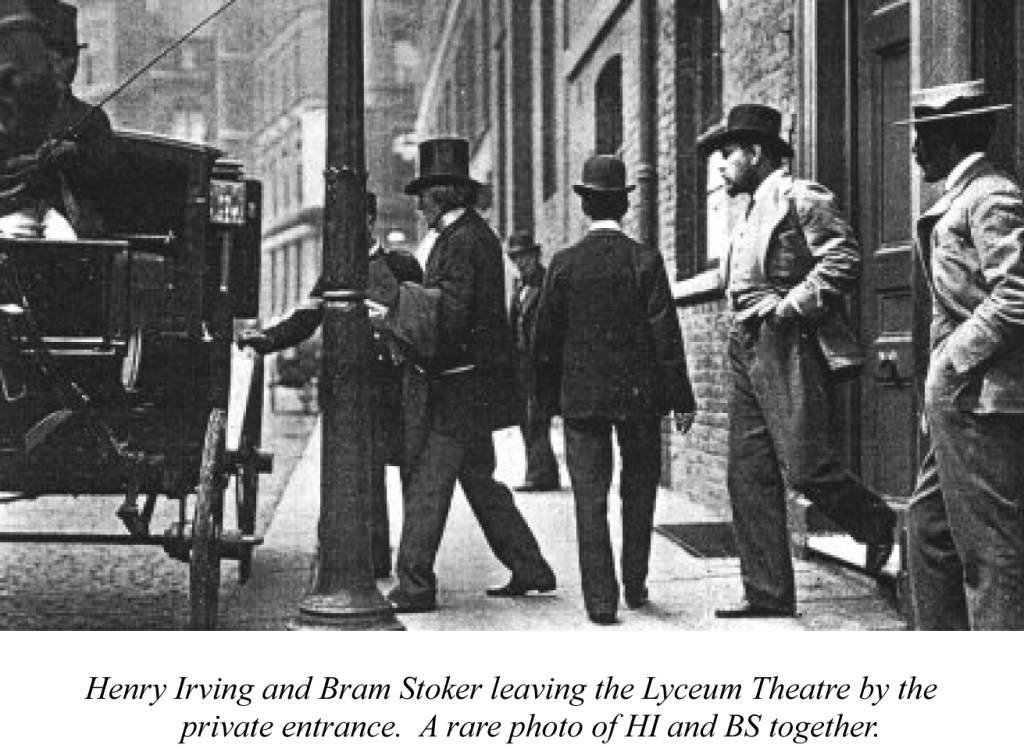
    Henry Irving and Bram Stoker leaving the Lyceum Theatre by the private entrance. A rare photo of HI and BS together.

  • The Irving Society Newsletter No 76

    The Irving Society Newsletter No 76

    The Irvingite

    FORTHCOMING IRVING SOCIETY AUTUMN EVENT

    At 11.00 am Monday 27 November, 2017, The Irving Society is planning an outing to the London Metropolitan Archives (40 Northampton Rd, Clerkenwell, London EC1R 0HB) to visit their exhibition Life on the London Stage. Entry to the exhibition is free and, following the visit, those who wish would be welcome to join us for lunch at 1.30 pm at The Quality Chop House (88-94 Farringdon Road, London EC1R 3EA ).

    Committee Member Paul Campion is kindly receiving RSVPs, which are required. As both the Archives and the restaurant have limited capacity, we need to provide them with an indication of numbers in advance. If you would like to join us, please do contact Paul at [email protected] and he will provide you with a booking form.

    Life on the London Stage is a new exhibition at London Metropolitan Archives which uncovers the lives of some of the actors and actresses recorded in our archives, capturing both professional and personal details that provide a glimpse of the challenges and joys of theatrical life since the days of Elizabeth I.

    Drawing on a wide variety of photographs, prints and documents, we have brought together a collection of stories which illustrate different aspects of the lives of London’s performers, from those who achieved great success to those who endured poverty and hardship.

    Documents recording the life of Edmund Shakespeare, William’s forgotten brother, appear together for the first time presenting the seemingly tragic story of the young actor who followed his older brother to London.

    Ledgers and letters document the lives of some of London’s most celebrated stars, including Kenneth Williams, Dame Ellen Terry and Eliza (Madam) Vestris. The houses associated with Nell Gwyn, surely one of London’s greatest rags to riches stories, are presented alongside Sir Laurence Olivier’s bespoke orders from one of the capital’s most prestigious boot makers.

    There are also those who were recorded by London’s authorities for less salubrious reasons, notably the actor Gabriel Spencer who fought a series of bloody duels in 1590s Shoreditch and Marie Lloyd, who alarmed the Victorian authorities with her music hall routines.

    Of course, alongside the famous names that live on through generations are huge numbers of working performers who have graced the London stage since the first theatre was built in London in 1576 but are largely forgotten today. They are remembered here in our displays of programmes and playbills.


    ROTTEN PERFECT AT THE WATT’S GALLERY, SURREY

    From Friday 29 September - Sunday 1 October, Lynchpin Productions present Rotten Perfect, a witty snapshot of the impassioned backstage lives of Ellen Terry and Henry Irving. Once the young wife and muse of G F Watts, Ellen Terry is now the leading lady at the Lyceum Theatre. Actor Manager Henry Irving is doing everything he can to keep his theatre up and running and to keep his star actress, but she is tired of coming second to his classical heroes.

    Friday 29 September – Sunday 1 October
    7.30pm
    £15 (£12.50 concessions)
    Watts Gallery


    REVIEW OF BRAM AND THE GUV’NOR

    Jefny Ashcroft’s play is designed to draw attention to the Bram Stoker archive held at the Shakespeare Birthplace Trust in Stratford upon Avon, where it is accompanied by an exhibition of an interesting selection from the archive.

    In the play, taking as a starting point the release from prison and disgrace of Oscar Wilde, she examines encounters between Henry Irving, Ellen Terry and Bram Stoker, Irving’s Business Manager, at the time of the first publication of ‘Dracula’, also in May 1897. Stoker, convincingly played by David Reakes, is anxious for Irving to stage a play based on his original gothic novel. Such a play was read at the Lyceum for copyright purposes; an original poster advertising that event was included in the exhibition.

    Commentators disagree on how far Count Dracula is based on Irving, and the well directed play is only able to hint at the subtle interplay of Stoker’s relationship with Irving. Barrie Palmer makes a brave attempt at a role which involves him in briefly portraying Dracula as played by Irving and Jo Price has no opportunity to be other than a leading actress, without Ellen Terry’s elusive charm. Jefny Ashcroft has done considerable research to set the play in context and, judging by reactions of members of the audience, it has whetted several appetites for more information about this fascinating period of theatrical history.

    Seeing the small selection of memorabilia on display makes one wish for an opportunity to see a much larger exhibition - surely one of our London museums could mount one, given the right encouragement.

    It is most heartening to know that Irving, his friends and colleagues still attract attention and interest 120 years after these events took place.

    - Paul Campion and Helen Smith


    IRVING SOCIETY MEMBERS PUBLISH NEW BOOKS

    The Society is delighted to share with the membership the news of a number of new books which have been published by members.

    Alan Stockwell’s new book MAN-MONKEYS: From Regency Pantomime to King Kong, was released on Vesper Hawk Publishing on 1 June.

    Did you know that men have been dressing up as apes for the entertainment of the public since 1801? Did you know that men have been dressing up as apes for the entertainment of the public since 1801? The first play to feature an ape as a character was La Perouse, a work that became standard in the repertoire of the theatres of the day. In 1825, the French dancer Mazurier became the sensation of Paris and London playing the lead in the ballet Jocko ou le Singe du Brésil. These two stage works made such an impression that an entire sub-genre of drama arose and held sway for 100 years and beyond, leading to modern times with King Kong and The Planet of the Apes on screen.

    Inside these covers you will find the stories of performers who specialised in playing dramatic ape roles – men like the ill-fated Parsloe who fell from stardom in London to die a lonely death in America, the irascible almost legless Hervio Nano, Teasdale who turned to God after stabbing his wife, and the simpleton potboy who was transformed into Monsieur Gouffe and made a fortune attracting the bon ton of London. Within these pages you will find some of the oddest, most unfortunate, ill-requited, luckless, and doomed performers who ever chose to tread the boards – the artistes known as ‘man-monkeys’.

    Further details can be found on the Vesper Hawk website, and a review of the book written by the Society’s Chair, Frances Hughes, will be included in the next edition of First Knight.

    Christina Britton Conroy researched her historical novel series, His Majesty’s Theatre, over many years. It is now being published by Endeavour Press, UK. Launch dates for the books - which are available on Amazon - are:

    Not from the Stars – Friday 18th August

    Filled with the history of the British theatre and allusions to Shakespeare, Not From the Stars is the first in the His Majesty’s Theatre series about the lives of the actors and academics who lived in the repressive days of Edwardian England, but refused to be stifled.


    But From Thine Eyes – Friday 15th September


    London, December, 1903. Seventeen-year-old Elisa Roundtree escapes her life in Yorkshire heading for His Majesty’s Theatre, hoping to become an actress. Filled with details of theatre life at the turn of the century, But From Thine Eyes will have you cheering for Elly, long before she ever takes the stage.


    Truth and Beauty – Friday 20th October


    “Readers will be immediately drawn into the story and find it hard to leave…” - Manic Readers


    Beauty’s Doom – Friday 17th November


    “Captivating… a real page turner.” - Mary Jones, WRVC Radio


    IRVING’S SIGNATURE AT SHAKESPEARE’S BIRTHPLACE


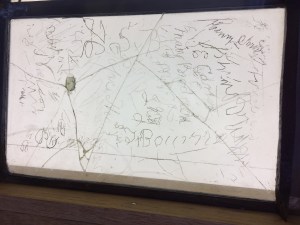
    Many thanks to our former Editor, Michael Kilgarriff, who sent through (courtesy of his daughter) this fascinating picture of a window at Shakespeare’s birthplace in Stratford-upon-Avon, a building he inherited from his father and let out as an inn. The image has been rotated so that HI’s signature can be seen scratched out in the top right-hand corner. Other famous signatories (though not discernible) include Ellen Terry, Thomas Carlyle and Walter Scott.

    More information about this story can be found on the website of the Shakespeare Birthplace Trust.


    The Henry Irving Foundation and the Henry Irving Correspondence Website

    It is ten full years since the Henry Irving Correspondence website came online. It is currently visited by an average of at least 60 people a day; from 109 different countries already this month. Use seems to be growing.

    Frances Hughes and I have worked recording the manuscript letters from 2003, and the database now contains summaries of over 9225 letters and documents, displayed in chronological order. There is still unrecorded material here and in America.

    When John H.B. Irving died last December the trustees of his Henry Irving Foundation decided to take stock. His charitable Foundation, with a few generous donations, had funded the website with its hosting costs, and the volunteers have worked without pay or expenses, but the funds are now almost exhausted.

    Unless we can find a new host or sponsor the whole site and its database will have to be archived by the British Library, where it will be frozen and not easy of access. Also needing a home is a large paper archive of the original records, including some full transcriptions not on the website.

    If any member of the Irving Society has ideas about a future for the site, please let Frances Hughes or me know. We can provide further details.

    - Helen Smith


    SAVE THE DATE FOR AGM / NOTICE OF MEMBERSHIP RENEWALS

    Members will soon receive their membership renewal forms for the 2018 membership year.

    Members are also asked to please save the date for the Society’s 22nd Annual General Meeting in celebration of Sir Henry Irving’s Birthday. This year’s festivities will take place on the afternoon of Sunday 11 February, 2018. Further details including a programme of the day’s event will follow shortly.


    MESSAGES TO THE SOCIETY

    The following messages have been received to the Society’s email inbox. Members and non-members wishing to get in touch should contact [email protected]

    MESSAGE FROM AUTHOR SUSAN WANDS

    Dear Irving Society,

    Friday, October 13th, there will be a book presentation of Magician and Fool, the historical fiction based on the life of Pamela Colman Smith, an artist who based her tarot card of The Magician on Sir Henry Irving. The presentation will be at Watkins Books, 19-21 Cecil Ct, London WC2N 4EZ, UK, at 6pm and will last approximately one hour. The presentation is free, with a question and answer period following the brief reading.

    Here is a synopsis of the book:

    In Magician and Fool, Pamela Colman Smith begins her career as an artist at the end of the Victorian Age at the Lyceum Theatre, where she grows from innocent empath to seer and channeler; creating her now world-famous deck of tarot cards. Introduced to The Golden Dawn cult by Bram Stoker, the second in command at the Lyceum Theatre, she is commissioned to create a tarot deck for the members to use in their quest for magic. Golden Dawn’s most evil member, Aleister Crowley, becomes obsessed with unlocking the mysteries of the Tarot. His obsession peaks when he sees the power of her deck and realizes he can create a rival deck, leading him to manifest magical power to harm Pamela’s incarnates of her cards. Sir Henry Irving, the actor/manager of his day, figures as the pivotal role of The Magician, as he leads her along her path as a talent and an empath.

    There is a website for the book and a Facebook page for the book and the book’s background materials.

    At the presentation, there will also be t-shirts and mugs with Sir Henry Irving as the center of the artwork as The Magician.

    I would like to invite the Irving Society to attend. Magician and Fool is the first book in a series of books based on the Rider Waite tarot cards. Sir Henry Irving is the main character through the arc of the series. I’ve attached artwork of the book cover and bonus merchandise that features Sir Henry.

    I would love to meet any members of the Irving Society.

    Cheers!

    Susan Wands

    Bookings can be made in order to guarantee a seat by visiting eventbrite.


    GENERAL NOTICES

    • Members are invited to submit content for inclusion in either of the Society’s publications. Submissions should be sent directly to [email protected]. Submissions for inclusion in The Irvingite will be considered by the Honorary Secretary, and submissions for inclusion in First Knight will be considered by the Editorial Sub-Committee.
    • And finally, as a reminder, should any members no longer wish to retain single or multiple back issues of First Knight, the Editorial Committee would be pleased to receive such copies to meet the needs of those seeking to fill gaps in their collection – lost or mislaid – or for the benefit of new members seeking to add to their collection.
  • The Irving Society Newsletter No 75

    The Irving Society Newsletter No 75

    The Irvingite

    THE IRVING SOCIETY HOLDS ITS 21st ANNUAL GENERAL MEETING

    Imogen Irving Lays the Wreath at the Statue of Sir Henry Irving
    The Irving Society’s Chair, Frances Hughes, Addresses Members at the 21st Annual General Meeting.


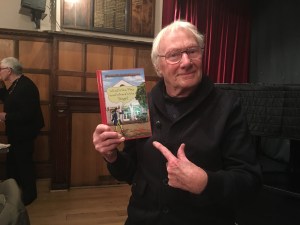
    Alan Stockwell with his Book, “What’s the Play and Where’s the Stage?”


    The Society’s 21st Annual General Meeting was this year held on Sunday 12 February 2017. As in previous years, members assembled at the Irving Statue on Charing Cross Road from 2.30pm for the laying of the wreath (which was ceremonially laid at the Guv’nor’s feet by new committee member and Sir Henry’s great-great-great Granddaughter Imogen Irving).

    At 3pm, the Annual General Meeting proceedings began at the Concert Artistes’ Association on Bedford Street. The Society’s Chair, Frances Hughes, led proceedings by thanking the committee, officers and Society’s members for another successful year. Particular thanks were recorded to Committee members and officers stepping down for the 2017 membership year, including Mike Ostler, Dr Varsha Panjwani (Honorary Treasurer) and Hilary Phillips. Thanks were also recorded to member Nick Bromley for his hosting of the Garrick Club dinner on 4 October 2017. The dinner was agreed by all to have been a great success, and it was noted in particular that Mr Bromley had been an excellent and engaging speaker.

    Warm wishes were also extended on behalf of the Society to long-standing member Virginia Surtees on the occasion of her hundredth birthday.

    Prospective activities proposed for the coming year included a lunch at the Two Brydges Club which could also, perhaps, dovetail with a historical walking tour of the area surrounding the club – the home to a number of 19th century theatres.

    Members were encouraged to continue to submit articles and materials for the Society’s twice annual journal, First Knight, and to help with spreading the word to others who might be interested in joining as members.

    The Chair’s report closed with a moment of remembrance for members who had passed away in the previous year, including Alan Wilson and the Society’s patron, John Irving. In particular, thanks were recorded to Angela Barlow who attended John Irving’s funeral on behalf of the Society and wrote a warm account of the Service for Issue no. 74 of The Irvingite.

    After the business of the meeting had concluded, members were entertained by fellow member Alan Stockwell, who discussed his excellent book What’s the Play and Where’s the Stage. What’s the Play and Where’s the Stage tells the story of the Jonas and Penley Company of Comedians – a theatrical family of the Regency Era. The discussion was a great success – and all copies of the book which had been brought to the AGM sold out! Sincerest thanks to Alan Stockwell for travelling into London for the AGM and for leading such a fascinating discussion.

    The day’s festivities concluded with refreshments and birthday cake in honour of Sir Henry.


    PERFORMANCE OF ‘TIS I


    On Sunday 9 April 2017, Robert Poulter’s New Model Theatre in association with Pollock’s Toy Museum Trust presented a special commission for The Irving Society, a performance of ‘Tis I. The performance, an examination of the life and working practices of the great Actor Manager, constituted three parts and an epilogue and was performed at the Art Worker’s Guild.


    LORD OF THE LYCEUM BROADCAST ON RADIO 4 EXTRA

    On 12 April 2017, Radio 4 Extra aired two broadcasts of member Professor Jeffery Richards’ Lord of the Lyceum. First broadcast by Radio 4 in 1988, Lord of the Lyceum celebrates the theatrical life and achievement of our first knight, Sir Henry Irving. The programme is available to listen to on BBC iplayer through 12 May 2017.


    ANNOUNCEMENT OF NEW COMMITTEE MEMBERS AND OFFICERS

    The Committee of The Irving Society is delighted to share with the membership the news of three new committee appointments. Joining the committee from May 2017 are Jennie Bisset and Imogen Irving. Also joining the committee, as well as assuming the role of Honorary Treasurer, is Dr Kristan Tetens. A further introduction to Kristan in particular, including details of how she can be contacted, will follow shortly. In the meantime, we are very pleased to have Jennie, Imogen and Kristan join us and look forward to working closely with them in the coming months.

    Grateful thanks are once again extended to the long serving committee members and officers who stepped down at the last AGM: Mike Ostler, Dr Varsha Panjwani and Hilary Phillips. Their presence on the committee will be sorely missed, but all have promised to remain active members of the Society and we look forward to welcoming them at future events and activities.


    FORTHCOMING PERFORMANCES OF INTEREST

    From Monday 15 May 2017 - Saturday 20 May 2017, a new play inspired by the Bram Stoker theatrical archive entitled Bram and the Guv’nor: Play and Archie Exhibition will be performed at the Shakespeare Birthplace Trust on Henley Street in Stratford-upon-Avon. The performance and archive display have been generously funded by Arts Council England and are free to the public. More information can be found on the Shakespeare Birthplace Trust’s website.

    Friends of the Society at Lynchpin Productions have also asked that members be notified of a forthcoming Irving related production which should be of interest. About the partnership between Henry Irving and Ellen Terry the play, Rotten Perfect, is securely based in factual research and also features Alice Comyns Carr. It’s a fascinating insight into the dynamics and difficulties of making theatre work at the highest level of the day. Conflict and humour abound to ensure a great evening. Rotten Perfect was first performed in the Barn Theatre at Smallhythe Place (home of Ellen Terry) in 2016. Having been extensively revised, planning is now well underway for a new production by Artifice and directed by Kate Napier at the Watts Gallery, Compton which will run from 29 September to 1 October 2017. The production will form part of the centennial celebration of the eminent painter George Frederick Watts - to whom Ellen was briefly married as a teenage girl.


    MESSAGES TO THE SOCIETY

    The following messages have been received to the Society’s email inbox. Members and non-members wishing to get in touch should contact [email protected]

    BRODRIBB GENEALOGY: INFORMATION REQUEST

    Members of the committee have been contacted by a friend, Gail Naughton, who will shortly begin work on the Brodribb Genealogy. Members who have any information or who might, perhaps, have done similar research in the past are encouraged to contact the Society so that this can be passed along - or so that they might be put in touch with Ms Naughton directly.


    MESSAGE FROM SUZ WINSPEAR

    The Society has been contacted by a former member, Suz Winspear, who is in the process of selling off her large and impressive collection of Irvingiana. The centrepiece of the collection is the 1893 Blackwell bronze plaque. Ms Winspear notes that, whilst it isn’t in perfect condition due to the marble having split, that it could most likely be repaired. The collection also includes large quantities of programmes, souvenir-publications, postcards, books and prints.

    Offers are welcomed, either for the entire collection or for individual items. Ms Winspear notes that she’s most concerned with the collection going to a good home where it can be thoroughly appreciated. Also up for consideration is a large collection of items related to Martin Harvey.

    Members interested in finding out more are encouraged to contact the Honorary Secretary so that they can be put in touch with the seller.


    MESSAGE FROM HENRY WILLIS

    The Society has also been contacted by an antique silver dealer in Dorset, Mr Henry Willis. He has recently acquired an American silver cup, which was presented by Henry Irving to Francis Cowley Burnand (playwright and editor of Punch Magazine) in 1901. The item is listed on his website.

    Members who are interested, or who might have more information about this item which could be added to build the story, are encouraged to contact Mr Willis directly.


    MESSAGE FROM SARAH-JANE HARKER VIVIAN

    Finally, the Honorary Secretary has been in touch with member Sarah-Jane Harker Vivian, who wishes to share the following news with the Society:

    The old Harkers Studios of my Great Grandfather’s and even where my Father worked are to be turned into luxury flats. Joseph Harker worked with Irving and Stoker and indeed his Father worked with Irving as a young man.

    I attach these articles from the Guardian and Spitalfields also:

    https://www.theguardian.com/stage/2017/feb/05/susannah-harker-family-joseph-harker-scene-painting-london-studio

    At Joseph Harker’s Paint Studios

    I hope to spread the word as much as possible before these studios are gone forever.


    GENERAL NOTICES

    • Members are invited to submit content for inclusion in either of the Society’s publications. Submissions should be sent directly to [email protected]. Submissions for inclusion in The Irvingite will be considered by the Honorary Secretary, and submissions for inclusion in First Knight will be considered by the Editorial Sub-Committee.
    • And finally, as a reminder, should any members no longer wish to retain single or multiple back issues of First Knight, the Editorial Committee would be pleased to receive such copies to meet the needs of those seeking to fill gaps in their collection – lost or mislaid – or for the benefit of new members seeking to add to their collection.
  • The Irving Society Newsletter No 73

    The Irving Society Newsletter No 73

    The Irvingite

    THE IRVING SOCIETY HOLDS ITS 20th ANNUAL GENERAL MEETING

    20th AGM

    Sunday, 21 February 2016 was a thankfully bright and warm day for our for Members as they gathered at Sir Henry Irving’s Statue on Charing Cross Road and watched Luke Irving ascend the ladder to place a wreath at his famous great-great-great Grandfather’s feet.

    After the wreath laying, the party assembled at the Concert Hall of the Concert Artistes’ Association in Covent Garden, London for the Irving Society’s 20th Annual General Meeting. Our Chair noted continued thanks to Member Glen Hayes – who is also of the CAA – for his continued help in ensuring that this annual gathering is a success. Thanks were also recorded to the newest Committee member Paul Campion who, in the autumn of 2015, organised a very successful trip for the Society to Northampton. A number of locations for future Society trips were suggested, and Members are encouraged to continue to share their ideas for such events with the Committee.

    Condolences were extended to the family and friends of Members who had passed away in the previous year, including Doreen Brown, Keith Hutton, Roger Mason, Brian Manvell and Nicholas Smith. In particular honour of the life and memory of Nicholas Smith, his poems Theatre (1963) and Last Night (1968) were warmly read in tribute by the Chair.

    The meeting concluded with updates on the Society’s membership numbers, financial position and new website – and with the re-election of all Committee Members and Officers. As business drew to a close, the Chair led all of those assembled in a chorus of Happy Birthday – both for Sir Henry Irving, as well as for our Vice Chair, Alex Bisset! Birthday cake duly followed.

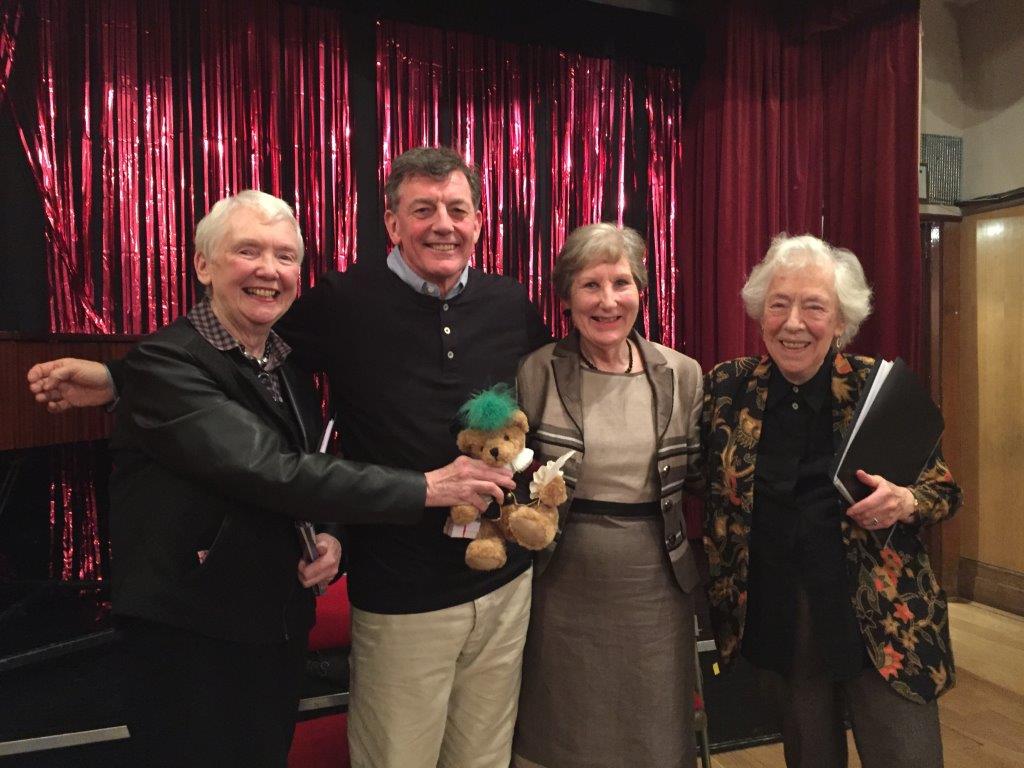
    Entertainment for the Society’s 20th Anniversary was especially memorable, as Chair Frances Hughes and Members Mary Greenslade and Rosemary Macvie joined actor Tony Wise in a light-hearted interlude for four voices: Reading the Will: 1616 – 2016 (pictured above).

    Thanks to all who were able to attend. Here’s to another 20 years!


    BBC SOMERSET INTERVIEW

    BBC Somerset Logo

    Our Chair, Frances Hughes, was interviewed by Claire Carter for BBC Radio Somerset on the morning of Monday, 21 March 2016. Topics of conversation included the Shakespeare 400 and Sir Henry Irving, Irving’s links to the Somerset area, and the work of the Society more generally. Many thanks to Frances for spreading the word about the Society and for helping to promote it in such a public way! We are hoping to obtain a recording of her interview from the BBC and, if successful, will send a link to members in due course.


    IRVING ANNIVERSARIES

    Dracula Cover

    The month of May brought two Irving related anniversaries. On 24 May 1895, actor Henry Irving was officially granted his Knighthood. And on 26 May 1897, Bram Stoker’s Dracula – for which Irving was claimed to be the inspiration – was first published.


    IRVING IN THE PRESS

    Members may be interested to see the following article, published recently in the Birmingham Post, and which mentions a connection to Sir Henry Irving. The article reports on the former Harborne and Edgbaston Institute, opened by Irving in 1878, and which served as an entertainment and cultural hub in Harborne for over 25 years. During its time as an arts centre, the Institute hosted an array of notable performances – even a supposed reading by the poet Hilaire Belloc! The Grade II listed building has undergone a number of changes in use over the past century and a half, most recently undergoing a transformation into a development of luxury homes.

    A brief mention of Irving’s association with the Institute can be found in the excellent book Sir Henry Irving: A Victorian Actor and His World by Jeffrey Richards.


    IRVING AND THE UNIVERSITY OF GLASGOW

    Throughout his life, Irving had a great number of honours bestowed upon him. Aside from his Knighthood, Irving was a member of the House Order of Combined Saxe-Coburg Gotha and Saxe Meiningen as well as Doctor of Letters of Dublin University, Doctor of Letters of Cambridge University and Doctor of Laws of the University of Glasgow.

    As for the last, thanks is sent to our former Editor and Society Member Michael Kilgarriff for unearthing the following piece from The Stage, published on 23 February 1899:

    “It is good news to learn that the University of Glasgow proposes conferring upon Sir Henry Irving the degree of Doctor of Law. When this has been accomplished Sir Henry will hold the degree for England, Ireland and Scotland — an honour that has never been the lot of any other actor. Sweets to the sweet, and Sir Henry deserves all that comes to him.”


    FORTHCOMING EVENT

    regency theatre conference image

    Theatre in the Regency Era: Plays, Performance and Practice: 1795 – 1843

    From 29 – 21 July, 2016 the Society for Theatre Research (STR) will hold its much anticipated conference: Theatre in the Regency Era: Plays, Performance and Practice: 1795 – 1843. The STR has invited fifty speakers to present papers at the conference and their subjects will explore the period’s dance, music and drama from a range of historical and methodological perspectives.

    The conference will be held on the beautiful campus of Downing College, Cambridge and in its traditional nineteenth century neo-classical rooms and Georgian inspired theatre auditorium, dating from 2010. The fully-restored college was designed in 1806 by William Wilkins the Younger, the architect who designed the National Gallery and the Theatre Royal Bury St Edmunds, among other significant buildings. The College’s theatre, also built in 1814, will provide a rare opportunity for conference attendees to see an original surviving Regency three level horseshoe auditorium.

    Members interested in finding out more about the Conference – or, indeed, booking a place to attend – should visit its dedicated website.


    REQUESTS FOR ASSISTANCE FROM THE SOCIETY:

    The following requests for assistance from the Membership have been recently received. If Members are able to help, please contact the Honorary Secretary at [email protected] and she will put you in touch with the relevant parties:

    MESSAGE FROM HOWARD OSTROM

    Howard Ostrom oversees an excellent website, the A-Z Index of Sherlock Holmes Performers, and he is seeking information about a particular performer, Clarence Hague.

    Hague, whose real name was James M Hague, was a Welsh actor born in 1857 and is known mainly for his roles in productions of Cymbeline, Henry VIII, Faust and King Arthur which were performed with Henry Irving’s Company between 1894 and 1895.

    Clarence Hague played a parody of Holmes (Hezekiah Hurlock Sholmes) in a 1900 production of R.F. and M.F.: or, the Two Are One. Mr Ostrom is seeking any information about – or photos of – this production.

    MESSAGE FROM STEPHEN HALL

    Stephen Hall (Programme Leader, Drama at the University of Winchester) has contacted the Honorary Secretary regarding a research/ creative practice project which he is presently undertaking. He wonders if members might be able to assist with providing information about James ‘Jimmy’ Allen.


    GENERAL NOTICES

    • Members are invited to submit content for inclusion in either of the Society’s publications. Submissions should be sent directly to [email protected]. Submissions for inclusion in The Irvingite will be considered by the Honorary Secretary, and submissions for inclusion in First Knight will be considered by the Editorial Sub-Committee.
    • Members are reminded that The Irvingite will now be published on the Society’s website. To continue receiving this publication by email, Members should subscribe by entering their email into the relevant subscription box at the bottom of the website. Anyone who requires assistance with this can contact the Honorary Secretary and she will be happy to help. Members without email addresses will, of course, continue to receive postal subscriptions.
    • At our most recent AGM an updated Constitution was put before the Membership, and this has now been ratified. Any Members who would like to receive a copy of these amended Rules should contact the Honorary Secretary.
    • And finally, as a reminder, should any members no longer wish to retain single or multiple back issues of First Knight, the Editorial Committee would be pleased to receive such copies to meet the needs of those seeking to fill gaps in their collection – lost or mislaid – or for the benefit of new members seeking to add to their collection.
  • The Irving Society Newsletter No 72

    The Irving Society Newsletter No 72

    The Irvingite

    MEMBERSHIP RENEWALS AND AGM SAVE THE DATE

    To all of our Members, we send belated Season’s Greetings and our wishes for a very Happy New Year!

    By now, you will have received your membership renewal forms for the 2016 membership year, but if they have not arrived with you please don’t hesitate to contact us at [email protected].

    The Committee looks forward to another exciting year of activities and publications, starting with the 20th Annual General Meeting. Please save the date for this annual gathering in celebration of Sir Henry Irving’s Birthday. This year’s festivities will take place on the afternoon of Sunday 21 February, 2016 and, after the ceremonial wreath laying at the statue to Henry Irving, we will once again adjourn to the Club for Acts and Actors in Covent Garden.

    The Committee also wishes to note that nominations for additional members of the Committee are gratefully received. All current Committee Members and Officers have expressed an interest in serving for another term, and this will be put forward to the members on 21 February.

    Agendas for the AGM, as well as formal membership cards for the 2016 membership year, will be distributed to Members in the coming weeks.


    NEW WEBSITE FOR THE SOCIETY IS LAUNCHED!

    The Committee is delighted to announce that The Irving Society’s much anticipated new website is now live! Special thanks must be extended to our website designer, Vicki Holland, for her hard work and dedication in designing such an exemplary and visually arresting site.

    The website address remains the same: www.theirvingsociety.org.uk. Members are encouraged to send any comments or feedback to the Honorary Secretary at [email protected].

    Please note that forthcoming issues of The Irvingite will be available on the website, together with regular news and updates. Members are asked to register as subscribers to ensure that they continue to receive timely, electronic news from the Society. Instructions on how to subscribe will be sent to Members by email prior to the next newsletter publication date in April 2016.

    Those Members without access to the internet will, of course, continue to be sent hard copies of the newsletter through the post.


    AUTUMN VISIT TO NORTHAMPTON

    28th and 29th September 2015

    A group of Irvingites stayed overnight and went to the Theatre Centre of Northampton to see Hairspray at the Derngate Theatre. Next morning we met the others who came by train from Euston on Tuesday. We made our way to the Guildhall where our member Paul Campion had arranged to start the best timed and informed day one could wish for.

    The Guildhall dominates the Square, its Victorian- Gothic frontage as fresh and delicate as finished by Edward William Godwin in 1864. Paul had engaged Kate Willis to guide us round.. First, outside where the history of Northampton and the figures who had participated in it ran across the front from the invasion of the Danes in the 12th century to the
    Civil War (where Cromwell had boots made for his army but moved on without payment), and on to Queen Victoria’s visit in 1844. A niche had been reserved for a group of cordwainers, the shoe makers who used only the best leather and techniques in their craft, still practised in Northampton albeit on a smaller scale now.
    Inside the building we saw the Great Hall and the Godwin Room decorated in the aesthetic movement style and so much of the original furnishings remaining that it is now a popular venue for weddings while still being used for its civic purposes.

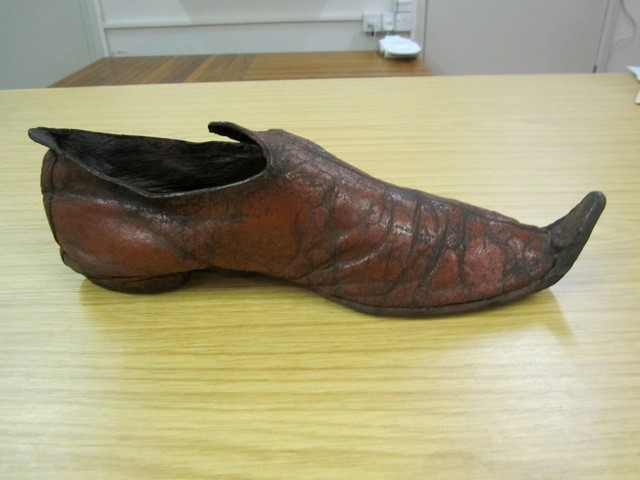
    Irving's shoe?Following lunch we went to the Museum which was celebrating its 150th anniversary. Paul introduced us to Rebecca who led us downstairs where we sat before a long table. On it she placed the shoe box. Rebecca gave a brief account of shoe making in Northampton and the Museum’s collection of 4,500 shoes, including those of Nijinsky and Little Tich. Then the opening of the box and the exhibition of the shoe we had all come to see! Frances identified it as possibly one of the pair HI had worn when playing Louis X1. Cameras were out, white gloves given to Alex who held it near his shoe size 9 and a 1/2 ? It was a treasure but was it Irving’s?

    We had a quick look around the varied theatrical shoes and other objects but then if we were to squeeze in the Rennie Mackintosh house we had to leave.

    78 Derngate had been designed by Charles Rennie Mackintosh in 1916. It was his final major commission. Although some of the original Mackintosh furniture had been lost there was still enough, with the unique wallpaper and artefacts, to envisage it as designed for Mr. Bassett-Lowke who appreciated it rather more than Mrs Bassett-Lowke! We put on the shoe protectors after seeing the garden and back elevation going to the kitchen, the sitting room and the bedroom.

    Time, then, to say goodbye with warm thanks to Paul and return to the station.

    “So you went all the way to Northampton to see a shoe from some actor?!” Yes, he was some actor and we saw not only the shoe but so much more besides

    - HILARY PHILLIPS


    ERNEST MOORE’S PORTRAIT OF IRVING

    The enterprising Barnsley Art on Your Doorstep project has undertaken a programme of research, and published a study of all artists born in the Barnsley, South Yorkshire, area.

    They applied to the Irving Society for help about the lost late portrait of Henry Irving painted by Ernest Moore. Committee members provided information and we have been sent a copy of their interesting volume ‘The Hidden Artists of Barnsley‘. (Another artist included, of theatrical interest, is the costume designer Sheila Graham, 1927-2009.)

    Irving on tour was several times entertained by the Sheffield Press Club and in 1897 they commissioned a portrait from the local painter Moore, 1865-1940, who was already established as successful in this genre. The researchers have found that it was some time before sittings could be arranged, in part due to Irving’s 1898 illness, and that they took place while he was convalescing in Cliftonville, near Margate and at his home at 15A Grafton Street in London. The portrait was unveiled in the new building of the Press Club on 6th December 1900 in the presence of Irving and Bram Stoker. The authors record that Irving and Moore got on well during the sittings, the actor finding the painter “a charming personality” and they remained friends. Three days before he died, on 10th October 1905, Irving gave Moore a signed copy of ‘The Merchant of Venice’.

    Only one letter related to this is on the Henry Irving Correspondence website (Letter 6635) but the Shakespeare Institute Library at Stratford upon Avon holds a dinner menu for the Press Club which reproduces a drawing by Moore.

    The project members have been unable to locate the portrait itself and think it may have been destroyed during the bombing in Sheffield in the last war.

    The attractive, sympathetic portrait was however engraved. A copy of the engraving was offered for sale from the Sharvell Martin collection and is reproduced in the Dominic Winter Auctions catalogue for 29 January 2015, Lot 720, which for the present can be seen on screen.

    - HELEN R SMITH


    CONGRATULATIONS TO DR KRISTAN TETENS!

    The Committee wishes to extend its hearty congratulations to Irving Society Member Dr Kristan Tetens who, in August 2015, completed her PhD at the University of Leicester.

    Kristan’s thesis, entitled ”Hall Caine, dramatist, with a special study of Mahomet (1890)’, was a study of a play based on the life of Muhammad, the prophet of Islam, that was written by one of England’s best-known authors (Hall Caine) for one of England’s best-known actors (Henry Irving).

    Her research interests include nineteenth-century British history and literature; the life and career of the English actor-manager Henry Irving (1838-1905) and his circle; the life and career of the English/Manx novelist Hall Caine (1853-1931) and his circle; representations of India and the ‘East’ on the Victorian stage; theatrical practice in British India; theatrical practice in the Ottoman Empire, especially court theatre in Constantinople c.1875-1900; dramatic censorship; theatre historiography; and digital humanities (especially multimedia applications for the study of Victorian history and culture).

    More information about Kristan’s research can be found on the University of Leicester’s website.


    IRVING ICONOGRAPHY

    The National Portrait Gallery is to publish as complete an iconography as possible for Henry Irving in the Later Victorian Portraits catalogue research series. Work is nearly complete but the following message has been sent by Carol Blackett-Ord who is the research worker. She is interested to hear of rare original works, perhaps in private collections.

    Portraits of Ellen Terry and Henry Irving at the National Portrait Gallery

    For the Later Victorian Portraits catalogue, see http://www.npg.org.uk/research/programmes/late-victorian-catalogue/later-victorian-portraits-search.php.

    As part of this project, the catalogue of Ellen Terry’s NPG portraits, and her worldwide iconography, have recently appeared on the Gallery’s Research website:

    http://www.npg.org.uk/collections/search/personextended.php?linkid=mp04458&tab=biography

    http://www.npg.org.uk/collections/search/personExtended/mp04458/dame-ellen-alice-terry

    http://www.npg.org.uk/collections/search/personextended.php?linkid=mp04458&tab=iconography

    Irving’s portraiture is drafted and will appear in the same format in the new year. Nuggets of information on rare or unfamiliar original portraits of Irving – no thanks to cuttings/prints, well covered – are still welcome, and privacy will be respected.

    Please contact Carol Blackett-Ord [email protected].


    GENERAL NOTICES

    • Dear Irving Society Members,
      Please accept my apologies for the delay in publication of the October edition of First Knight. This has been the result of surgery I underwent during the Autumn. This edition will be with you very soon.
      Piers Henderson
    • Members are invited to submit content for inclusion in either of the Society’s publications, and submissions should be sent directly to [email protected]. Submissions for inclusion in The Irvingite will be considered by the Honorary Secretary, and submissions for inclusion in First Knight will be considered by the Editorial Sub-Committee.

    As a reminder, should any members no longer wish to retain single or multiple back issues of First Knight, the Editorial Committee would be pleased to receive such copies to meet the needs of those seeking to fill gaps in their collection - lost or mislaid - or for the benefit of newer members seeking to add to their collection.


    IN MEMORIAM

    Finally, it is with great sadness that we must share news of the passing of two greatly admired Members of The Irving Society: Doreen Brown and Nicholas Smith.

    Doreen Brown was a long standing member of The Irving Society as well as, for 17 years, the Chair of the Shakespeare Reading Society. Her funeral was held in St John’s Wood, London on 1 December 2015.

    Founding Irving Society Member and well-known actor, writer and musician Nicholas Smith passed away on 6 December 2015. Members will also recall his enjoyable poetry, which he was kind enough to share with the Society during a reading held some years back. An article focused on his acclaimed career and writings will be featured in a forthcoming edition of First Knight.

  • Irving’s Audience – Annual Lecture by John Pick

    Irving’s Audience - Annual Lecture by John Pick

    Students of Henry Irving’s majestic reign at the Lyceum Theatre are, I think, prone to repeat three fallacies about him and his audience. First, that he was almost single-handedly responsible for, and indeed led, the theatrical boom of the late nineteenth century. Second, that he was a simple country boy with little interest in politics who was driven by a burning desire to make the theatre ‘respectable’ particularly in the eyes of the Royal family. And third that the relative decline in his fortunes later in life - the thirteenth season in 1891 was the last Lyceum season to make a profit - was simply down to the fickleness of the public, deserting the man whom they had once blindly adored, but who had now become ‘old fashioned’.

    I disagree with all three assumptions. I think Irving was, in one important sense, a supremely political animal, very much aware of the murky power struggles of the mid-nineteenth century and that he pursued his own moral and political ends with dogged skill. I don’t think that the varying attention he attracted can be satisfactorily explained by fluctuating ‘fashions’, or by something so random as fickleness. Far from being at the forefront of the great theatrical boom tide of the eighteen-nineties I think he was cut off and isolated by the power of its surge, though appalled by its shallowness.

    We talk of our own time as a time of great change, but I do not believe it can be a time of such change as Irving witnessed. From a boyhood spent walking the Somerset and Cornish lanes, he lived to see motor cars in the London streets. The first box of matches was just coming on the market at the time of Irving’s birth; by his last years virtually every leading theatre company except his was lit by electric light.

    When he first arrived in the City as a boy of ten, Greater London had a population of just over two million; when he played his twelfth (interim) Lyceum season in 1889 it had grown to six and a half million. His potential audience was by then very much greater than that. The audience travelling into Central London each evening, by car, by tram, by omnibus and particularly by train was estimated at the turn of the century to be in excess of twenty-five thousand. The railways in particular had grown prodigiously, and the establishment of the day excursion greatly extended each London theatre manager’s potential catchment.

    So we have immediately to confront one unavoidable fact. Irving’s ‘market share’ of the reachable London audience steadily declined throughout his Lyceum reign, and fell catastrophically in the 1890s when, as we shall see, he was faced with increasing difficulty in filling some parts of the Lyceum. Of course that was, in part, because of the unprecedented strength of the competition. For there has never been, before nor since, so large a provision in London for public entertainment as there was in the last decade of the nineteenth century. When the young Irving first arrived in the capital in 1848, there were in total just nineteen London houses. By 1900 there were sixty-one fully-fledged theatres, in addition to a further forty officially licensed music halls.

    The theatres were by no means the whole of the London leisure scene at the end of the nineteenth century. The great art displays - including the recently opened Tate Gallery - took their place alongside the museums, the public lectures and the concert halls. The Crystal Palace, at Sydenham, was still going strong, as a choral venue, as were the panoramas and the dioramas alongside the new moving picture shows - such as the one at the Empire in 1896 - the skating rinks, the menageries, waxworks, circuses, magic shows, balloon ascents and ‘thrilling acrobatic displays’. It is estimated there were still more than five thousand street entertainers of various kinds on the London streets. There were also two hundred thousand prostitutes. Great crowds still gathered at holiday times in the public parks, the commercial pleasure gardens and on the river - and in London there was now an additional attraction, professional sport - which attracted huge new, largely male, crowds. Scarcely any account of London’s leisure life in the 1890s is complete without an account of a visit to a boxing match. Crowds of thirty thousand watched the cricket at Lords in summer, and in winter more than seventy thousand sometimes watched such well-known soccer teams as Woolwich Arsenal.

    In the eighteen-nineties catering for leisure was already a full-scale business, or, as we might nowadays say, an ‘industry’. It was already linked with the business of tourism and in 1895 when the great new exhibition centre at Earls Court attracted more than four million visitors to its Festival of India and Ceylon it was held to be a triumph because a third of its attendees were visitors to the capital. Passing trade, on which the theatre managers had once largely relied dwindled to practically nothing. Now, visitors to London bought packages (train, hotel and theatre tickets combined) from the rapidly proliferating tourism agencies which, as Charles Dickens Jr. wrote in his London Guide of 1879, had already ‘assumed a rather important place in the economy of London’.

    The combined results of the introduction of advance booking and the associated development of party booking meant that investment in London theatre was much less of a gamble than ever before. Popular theatre productions could settle into long runs. In the eighteen-forties only five plays had runs of more than a hundred performances. In the eighteen-nineties one hundred and sixty-nine played more than a hundred performances and twenty-four of these had a run of over three hundred. It was the bigger theatres that tended to house the blockbuster shows. Drury Lane, whose capacity during the eighteen-nineties never dropped below three thousand, had no fewer than fifteen runs of a hundred performances each in that period.

    For some, investment in leisure provision was becoming hugely profitable. The bigger promoters were beginning to sell their branded products to an ever-expanding market. Everyone has seen photographs of several Fred Karno’s troupes setting out from London. The D’Oyly Carte Opera Company also subdivided into two, and sometimes three distinct companies. Even Wombwell’s Menagerie had a number one, number two and number three touring outfit! But a distinctive product such as the Lyceum Company could not subdivide itself into profitable touring parts, for it depended supremely upon one man. The occasional forays of the Lyceum Summer Company were always ‘By permission of Henry Irving’. That man, for reasons I shall suggest later, was resistant to being ‘rebranded’ as a consumable product and had little interest in the opportunistic capitalism of the new breed of turn-of-the-century theatre managers.

    Irving’s comparative failure in the eighteen-nineties was, I think, less a matter of his acting being old-fashioned than of his managerial philosophy and methods being out of their time. The business climate rather than popular taste had swung against him. It was the age of such as Sir Augustus Harris an actor turned impresario, manager of the Palace Theatre, air-conditioned and with two thousand-odd electric lights was ‘the best-equipped theatre in the world’. The music-haIl, once owned by the working class, was now largely a capitalist enterprise. In the early eighteen-nineties London had its first music hall (or variety theatre) syndicate, a new organisation called Moss’s Empire Palaces, capitalised at £1,500,000, built its first provincial theatres and, by the end of the decade, Moss Empires had spread into the heart of London. Businessmen who had made a packet in other fields were being urged - for virtually the only time in British history - to put their money into the successful parts of theatre business where it would be safe! As early as 1887 the Financial News was recommending (15th February) that investors put their money into the music hall, remarking, prophetically enough:

    ‘… whenever it had been decently and prudently managed it had yielded large fortunes …if it continues to refine itself and heap novelty on novelty as it does, it will go on growing.’

    It was plain where investors’ money would go. In 1902 Moss Empires were paying a 12½% dividend to their shareholders. In the same year Lyceum Ltd. finally went into liquidation, its £1 shares being valued at 7d

    Let me give one further example of the way in which the rampant new theatrical commercialism undercut Irving’s company. We know that the Lyceum was, in commercial terms, over-reliant upon the drawing power of one man and that when in the late eighteen-nineties, Irving was out of the cast - as he was, following his fall after the opening night of Richard Ill - the box office fell alarmingly. We know that in a doomed attempt to cut costs Irving reduced insurance premiums and was almost put out of business following the mysterious fire, which destroyed the contents of his scenery store. But Irving had been losing money on his London seasons since 1892. And one reason – in addition to much else - was that, in an attempt to compete with the new commercialism and hold his market share, Irving had been forced to raise his advertising costs well beyond his means.

    In the second half of the nineteenth century London was a billposter’s paradise. So extensive were all the building and rebuilding projects in Central London that there were then vast acres of fencing and exposed walls on which the official billposters and the more chancy flyposters could practise their art. The old charge of the billposters of Id. per double crown rose in the eighteen-nineties to 2d. or 3d. for prime sites, and the billposting costs per season rose from the £40 or £50 pounds annually of Irving’s early years to an annual expenditure of several hundred pounds. But that was nothing in comparison with the hugely increased costs of newspaper advertising. The removal first of Stamp Duty and then of Advertisement Taxes, the invention of the steam printing press, the growth in literacy and increased prosperity (and, it has to be said, the arrival of another group of profit-hungry entrepreneurs,) all combined to create an explosion of national and provincial newspapers without equal in our history. Irving’s expenditure on newspaper advertising rose annually from a few hundred pounds in the eighteen seventies to several thousands in the eighteen-nineties.

    Irving could not afford to advertise in more than a tenth of the possible outlets and, compared with the music hall syndicates and the growing theatre circuits, the Lyceum’s expenditure on advertising was inadequate to the task. To stand any chance at all, the Lyceum then needed to advertise itself as a part of a package but it was on its own. Irving lacked the means to refresh his audience with young people and, although the audiences for the music halls and the new West End theatres in general grew younger, Irving’s Lyceum audience aged with him.

    I believe Irving had much more political awareness than is normally granted to him. By the more usual account, Irving was a simple country boy, impatient at his lessons, fascinated by the magic of theatre and blind to everything else - a noble savage who after many hardships succeeded in conquering the sophisticated world of London and London high society.

    It is noticeable that most people who write about Irving’s early life will write a brightly-lit, almost idyllic account of his West Country childhood, but will say little or nothing about his surroundings as a boy in London. Then the background is darkened. We are told a little about his schooling, his extra curricular drama lessons, his visits to see Phelps at Sadler’s Wells, his first amateur stage performances, but nothing about life on London’s streets. The implication is that the young Irving drifted through the city unaware of the political turmoil of the times.

    One perennial problem is that Irving’s professional life more or less spans what we blandly call the Victorian Age. The term conjures up sanguine decades of prosperous formality. The Victorians are pictured as being, in general highly industrious, family-minded people who, like Gilbert’s pirates, all loved their Queen. Give or take a few technical changes, we generally assume that Victorian life in the eighteen-nineties was much the same as Victorian life had been in the eighteen-forties. As the historian G. M. Young rightly says:

    ‘If it had been the Queen and not Prince Albert who had died in 1861, the process of English history would have been far easier to apprehend. The long life of the sovereign, the long careers of her most famous subjects, created an illusion, which the word ‘Victorian’ enshrines.’

    For the truth is that when the ten-year-old Irving arrived in 1848 London was, in Herman Melville’s words, a damned city, a ‘city of Dante’. Clouds of smoke darkened the skies all day, and neither homes nor streets were adequately lit. In 1849 the Illustrated London Newsremarked that the city around St. Paul’s was ‘blackened and encrusted with a hard mixture of cement of smoke, cobwebs and rain’. Children of the young Irving’s age were working in the brickfields north of the city, in the mines to the east of it and in the sweatshops of London for between eleven and sixteen hours a day. Many children were already hardened criminals. Of the sixty-two thousand persons taken into custody that year in London, some sixteen thousand were under the age of twenty.

    The grim battle between law and lawlessness was played out in public. The young Irving will have seen the bodies left swinging from the gibbets outside London’s twelve prisons - public executions were not abolished until 1868 - and will have heard the prisoners begging from the open prison windows by the roadside. There was one notable window not far from his home, in the Fleet Prison on the Farringdon Road. He will have seen the soup kitchens in the East End, in Clerkenwell, and the beggars huddled under the stair-wells, even perhaps seen them down in the docks loading the hulks which were still transporting several thousand people a year to Australia.

    The city was still grotesquely unsanitary. Irving’s arrival in London coincided with a dreadful outbreak of cholera, which continued to spread its ravages until the autumn of 1849. In the words of the rapidly commissioned Board of Health the cholera raged ‘wherever neglect, depression, vice or poverty’ pressed down upon the population’, which was almost everywhere, while in central London:

    ‘foul drains, overflowing cesspools, foetid waters, overcrowded lodging houses, damp cellars, and ill-ventilated rooms attracted the pestilence, which then spread to the houses of the better classes and to the mansions of the rich’.

    In such a diseased and dangerous city, the theatre was more than a leisure indulgence for a bright young lad. However primitive, it was a place of light and warmth, and a more sanitary place than most domestic dwellings.

    But the early Victorian theatre was much more than that. It was a popular forum for the most intense debates of the day - debates that seemed at the time of lrving’s arrival in the capital, to be leading inevitably to the overthrow of the Queen and the establishment of a British Republic. For perhaps the most startling fact about Henry Irving’s arrival in London was that it was the year of the second French Revolution and the establishment of the French Republic.

    chartist demo
    Chartist demo

    There was turmoil in every European capital, and London was no exception. In April 1848 the Chartists announced that they would rally in great numbers on Kennington Common and march from thence to the House of Commons, to present a monster petition, containing several million signatures, demanding a general male franchise. The idea got abroad that 10th April would be the day of revolution. The Queen, who had already survived three assassination attempts, was spirited from the capital. The Duke of Wellington took charge of the official defences. London was put under curfew. One hundred and seventy thousand special constables were sworn in to keep the peace. Regular troops were secretly stationed in houses on all main roads. All river shipping was in the hands of the police. Private vehicles were banned from the streets. The Tower guns were mounted. The Bank of England was sandbagged. Two thousand stands of arms were issued to the Custom House, Exchange and - strangely, to our eyes - to the officials of the General Post Office. On Kennington Common itself six hundred Household troops took up their positions.

    There was no revolution - then. But tension remained high in the capital. Riots remained common, and the authorities’ fear of the mob is illustrated, as much as anything, by the fact that Trafalgar Square was actually built with pill boxes at each corner to fire upon the expected revolutionaries. London’s artists and intellectuals were right at the heart of the dangerous currents, which swirled around the capital, to the extent that for a decade or so the phrase ‘literary men’ was almost synonymous with ‘revolutionary’. London’s theatres had a pivotal political importance. It was in the capital’s theatres - particularly during Lent - that the Chartists, the Anti-Corn Law League and the Reform League habitually held their meetings. Even more importantly, in some theatres a play which read innocuously on the printed page could be given a revolutionary significance by the way the audience chose to read it. So some theatres - whose programme seemed above political reproach - nevertheless became known as radical theatres.

    Such was Sadler’s Wells. The conventional reading of Samuel Phelps’ tenure at that theatre is that the actor tamed an uneducated North London audience disposed in their ignorance to be unruly. Reading contemporary accounts of the lively and highly partisan Sadler’s Wells audience suggests something rather different. Not that Phelps tamed them, but that he became their voice. For lslington, far from being a centre of Victorian yob culture, was a radical hotbed, and Phelps’ audience included, from the first, many of the leading artist/revolutionaries of London. In 1847 the Times described Phelps’ audience as ‘comprising a singular number of literary men - and ladies - of the present day.’ Dickens, for example, was a very frequent visitor. So the Shakespeare heroes that were most consistently successful in Phelps’ repertoire -Macbeth, Richard III, King John, Pericles - in addition to their other merits, took on a highly charged political significance.

    It was that theatre, with its eager, highly politicised audience, which caught the young Irving’s imagination. In later life, it was to Phelps’ influence that he most often referred. So why then, in 1856, did he not accept Phelps’ offer and join his company at Sadler’s Wells?

    Irving, aged 17
    Irving, aged 17

    The answer, I believe, lies in the young Irving’s political acumen, as well as in his cautious character. Irving was far from being a political hothead.

    He was, I believe, torn between an innate sympathy with many of the radical causes of the time, and a terror of the carnage that would be unleashed if such causes were too blindly followed. At that time, it was far from clear whether the establishment or the radicals would prevail, and whether London would not witness a Terror as great as that of France. I think therefore that he turned down Phelps’ offer, not out of artistic prudence, but political caution.

    I would call as evidence the fact that, in February 1856, after he had turned down Phelps’ offer but had nevertheless determined to go on to the stage, he wrote to his cousin Mrs. Wilkins:

    ‘Evangelical and political events of no common order are brewing. The great Evangelical question is with reference to the opening of public exhibitions such as the British Museum, National Gallery and Crystal Palace on Sundays. Dickens’ new work (the first number of which had a circulation of 35,000) is written in favour of the opening, and he puts forward in a very ingenious manner (though under a cloak) the advantages arising from such a step. Dickens is a moralist but nothing else’.

    There speaks the young politician! ‘A moralist and nothing else…’ Irving pities the politically naïve… He goes on:

    ‘The great political question is the establishment of peace: much will depend on the issue of that. It is very interesting to watch the movements of the different bodies…’

    He was then just eighteen. I think the political education he gained in those adolescent years, in a turbulent London, determined his political and managerial character, and determined which audience he wanted to speak to, and in what voice.

    The similarities in the references, during the early years of Irving’s reign at the Lyceum, to the literary and artistic composition of his audience are quite striking. When we have reminded ourselves that, even in the eighteen-eighties, ‘leading artistic and literary figures’ is still code for ‘radical’, we can perhaps guess at a part, at least, of Irving’s intention. He wanted the Lyceum to have the same educational and intellectual force that Phelps’ theatre had enjoyed in lslington. We do him, I think, a disservice if we assume that his carefully composed first night receptions, his long suppers and conversations in the Beefsteak Room, his gruelling schedule of public lectures and debates, the carefully-contrived symposia in The Theatre, were simply a public relations exercise, or a convoluted attempt to achieve respectability for his profession. Cautious by nature, Irving wanted the Lyceum to generate and be in the forefront of political and intellectual debate.

    That intellectuality does not accord with the picture sometimes presented of Irving as a theatrical hack, wasting his great talent on crude melodrama, whose only merit was to get a few ageing bums on seats and unable at the end to come to terms with the new theatre of ideas that George Bernard Shaw, in particular, was promoting. But I don’t believe in that picture. I think Irving’s choice of plays was always motivated by much more than financial expediency, was infused with a keen moral sense, and was often of high political importance.

    Most people would agree with that view, if they consider it against his then revolutionary interpretation of The Merchant of Venice, and also when considering in its political context, The Bells. It is much more than a commercial war-horse. Much of the rest of his repertoire could benefit from being reconsidered in the light of the contemporary political situation. We might like for instance to reconsider his lifelong fascination with French history and the French Revolution. Perhaps we can now understand Ellen Terry’s incomprehension when, towards the end of his professional life, having refused her very practical suggestion that he should go on the road and cash in on his fame as a speaker of Shakespeare, saw him playing – ‘Just Henry and 200 extras - in Robespierre’. And we almost certainly underestimate just howdangerous were some of his choices, Faust for example, at a time of high religious passions. Almost every item in his programme becomes more interesting when it is considered in its immediate political context.

    Let me focus just on one event in Irving’s stewardship when, in the early autumn of 1888. he surprisingly announced that he intended to discontinue the run of Faust, which was still doing good box office. At that time Irving will have looked like what he undoubtedly was - a well-established and successful London theatre manager, making plenty of money from a well-established and long-running production, and mixing easily with Britain’s literary and artistic élite. There was little outward sign remaining of the cagey young political animal who had turned down Phelps offer of work twenty-two years before.

    An invitation to supper in the Beefsteak Room was still eagerly sought by London’s great and good. There they would meet leading artists, politicians and thinkers, probably Freemasons like Irving himself. A year previously, Irving had helped found the Savage Club Lodge, composed virtually exclusively of literary and theatrical leaders. They might even meet the Prince of Wales, who was not only a patron of the Lyceum but who had, for fifteen years, been Chief Mason, the Most Worshipful Grand Master of England.

    With a commercial and critically acclaimed success on his hands, it seems the more surprising that Irving should have announced that he was replacing Faust with the Scottish play. Macbeth was to open on 29th December with Ellen Terry as Lady Macbeth and Irving repeating a role in which he had hitherto been only partially successful. Had he been concerned simply with commercial success, it would have seemed strange at the least. Had he been concerned only with artistic quality - if such a thing were possible - it would have been an unnecessary risk. Considered as a piece of political theatre, it was a masterstroke.

    As always, look at the context. Revolution was still bubbling beneath London’s surface - the previous autumn a hundred thousand unemployed had clashed with the army in Trafalgar Square in what was being called Bloody Sunday. London’s Masonic Lodges, far from being secure dining clubs for the privileged, had been buzzing again with rumours of the imminent collapse of the established order, and they had sent to their own Worshipful Grand Master a series of letters imploring him to behave as might become a future monarch worthy of the title.That summer there were new and terrifying rumours. A series of killings in the East End of London, seemingly at random, of poor, down-and-out young women in the Whitechapel district were being linked with one apparently deranged killer called Jack the Ripper. Worse, the killer was being linked by rumour to the Freemasons - another popular name for him was Old Leather Apron. Worse still, rumours about the murders also implicated the Royal Family, specifically the Prince of Wales. It was even said that the Worshipful Grand Master had ordered the killing because the girls had all at some time been engaged as staff to the prince’s son, Prince Eddy, after he had, illegally, married a Catholic girl and had a child by her. The girls, it was rumoured, had made a clumsy attempt at blackmail and now had to be silenced.

    Whatever the truth, if any, of such stories, there is no doubt that the mood in London late that summer was one of near hysteria. And there can be no doubt that the significance of ‘the Ripper’ was debated in every salon in London, in every Masonic Lodge and of course in the Beefsteak Room at the Lyceum. There is no doubt that Irving heard much speculation about it and, perhaps, something of the truth behind the murders. Rumours about ‘the Ripper’ began to circulate early in summer, following the murder of Emma Elizabeth Smith on 3rd April. On the last night of his twelfth season, which was 7th July, Irving announced to a surprised audience that he would be discontinuing the run of Faust. Between 31st August and the 9th November the five undisputed victims of ‘the Ripper’ went to their deaths. Irving, on holiday in Paris, surprised his friends by the morbid pleasure he took in visiting the Paris morgue. He returned to rehearsals and on Saturday 29th December 1888, with the rumours of treachery in high places, Royal duplicity and bloody murder still bubbling in every pub in London, Irving opened Macbeth.

    Very many people, including Ellen Terry, thought that to be the high point of the Lyceum story. After Macbeth, according to some accounts, Irving lost some of his mighty powers. Perhaps so, but that winter of 1888 was something of a watershed in British political life. In the eighteen-nineties the forces for liberal reform, economic growth and technical progress increasingly came together. The Reform Acts 1884/5 had given the vote to a great majority of adult males. Forster’s 1870 Act had introduced state education for all. The real value of the average wage had almost doubled since 1850.

    The political agenda had moved on and Irving’s core London audience moved on with it. The average occupancy for the Lyceum performances fell steadily throughout the I890s, but it was in those areas of the house associated with the old literary intelligentsia - the pit and the boxes - that he suffered the greatest fall.

    He continued to hold his audience in the provinces - particularly in such radical cities as Manchester - and of course there was still a substantial following in the circle and stalls. In addition to its increasing age, the Lyceum audience had one other unfortunate characteristic, which it shared with its parent. It was, like the Lyceum company, overwhelmingly male. As I have many times been reminded by my students, whom I have asked to read Bram Stoker’s memoirs of Irving’s Lyceum years, that most dutiful of chroniclers’ rate of droppage of male to female names is at a ratio of about thirty-five to one. And although artists loyally include a fair proportion of women in their drawings of the Lyceum audience, the number of reminiscences of Irving’s London performances written by women is suspiciously low. One has sometimes to remind oneself that the Theatre was not everywhere a male preserve, and that there were some great London managers - Sara Lane (Britannia Theatre) and Emma Cons (The Old Vic) for example - contemporary with Irving’s Lyceum management.

    Irving never yielded to the new managerial commercialism, never doubted that the theatre had a higher purpose than making money – but his political focus remained rooted in the great concerns of the middle of the century. In later life he found new political issues shallow - it helps to explain his irritation with Shaw - and as a result one section at least of his contemporaries found him utterly insensitive to their concerns. One of the least-reported facts about his funeral was that the service took place against a highly audible background of jeering by the new Suffragettes, who picketed the Abbey. Ironic perhaps that his send-off should have been a hostile political demonstration.

  • The Irving Memorial by D. F. Cheshire

    The Irving Memorial by D. F. Cheshire

    For the last four years the Society has marked the anniversary of the birth of Sir Henry on 6 February 1838 with a ceremony at the foot of his statue on Charing Cross Road, London, incorporating in it an attempt to place a wreath at his feet some nine or ten feet off the ground - not it must be admitted entirely with altruistic intent but as an attempt (recently highly successful) to prevent the wreath being stolen instantly.

    Henry Irving StatueSociety members know about Irving but what of this statue? Who was responsible for its erection? Who designed it and have its surroundings always been the same?

    The statue was erected by the Irving Memorial Committee on land donated by the City of Westminster. The Committee, formed in December 1906 with Sir John Hare as Chairman and Charles Cruikshanks as Secretary decided straightaway that a subscription list would be opened - but (as the inscription on the base puts it) only to ‘English actors and actresses and…. others connected with the theatre in this country.’

    Sir Thomas Brock R.A. was prevailed upon to take the commission but work was delayed for some time as the Committee and the sculptor differed in their views of how Sir Henry should be dressed.

    The Committee generally favoured a costume associated with one of his famous parts, the sculptor favoured mufti. In the event the sculptor’s view prevailed - but interestingly enough (even though Brock might not have viewed it as such at the time) Sir Henry is still in costume his D. Litt.(Cantab) gown, for one of the parts he ‘played’ off-stage - the academically-minded actor. Underneath he is wearing a well-cut suit of the type he favoured when making personal appearances at the myriad civic lunches and statue-unveiling ceremonies with which he was regularly involved once he became ‘the leader of the English Stage and he has his right hand on his hip - another very characteristic gesture which either Brock knew from personal experience or which he picked up from the many caricatures and sketches in which it is featured. Sir Henry is hat-less (or rather mortar-board-less) so that his famous mound of long hair may be clearly seen. All in all it is one of the most successful portrait statues in central London and demonstrates clearly why Brock was one of the leading sculptors of his day.

    Brock’s first major work was the Prince Consort for the Albert Memorial which he in fact completed following the sudden death of the original designer, John Foley, for whom he was working as an assistant. It was only natural, therefore, that Brock should be made responsible for the Victoria Memorial in front of Buckingham Palace. A commission for such a monument at such a time was obviously fraught with difficulty.

    The Queen had died on 22 January 1901. Her son, Edward VII was due to be crowned on 26 June but due to his perityphlitis the coronation had to be postponed until 9 August. Thereafter he was kept busy with not only the social occasions with which his image is inextricably woven but also a whole range of important, very politically-charged, state visits until he was taken ill suddenly and died on 6 May 1910 - when work on the Victoria Memorial was reaching its conclusion and the casting of the Irving statue should have begun.

    The Times published a series of letters and reports on the subject. Charles Cruikshanks wrote to the Editor (3 March 1910) ‘The work in connection with the above [i.e. the memorial] is nearing completion and it is anticipated the statue will be erected towards the end of June or the beginning of July.’ But by then The Times had had to report (11 June 1910) that ‘The sculptor finished the plaster model for the statue some months ago, but the casting of the figure in bronze has taken more time than was expected’.

    Hare then sent a letter to the Editor of The Times on 15 July:

    ‘I have received a communication from Mr. Thomas Brock, R.A. to the effect that he finds it impossible to satisfactorily complete the Irving statue until August. As it would be most undesirable that the unveiling should take place at a season of the year when the majority of subscribers will be absent from London, the committee have decided not to fix the actual date for the ceremony until after the holidays.’

    On 5 November the Committee inserted a notice in The Times’ Court Circular:

    ‘Sir John Hare will unveil the Irving Memorial … towards the end of the present month. The work of erecting the statue will be completed on November 16’.

    On 17 November Hare was at last able to give precise details of the ceremony:

    ‘May I ask you kindly to let it be known to those interested in the unveiling of the statue of the late Sir Henry Irving, to be erected at the rear of the National Portrait Gallery, in the Charing Cross-road that the ceremony will take place on Monday, December 5, at 11.30 a.m. Accommodation for subscribers to the memorial fund and the Press will be provided; and in addition the committee have reserved a certain number of seats for special allotment.’ ( The Times 18 November.)

    Sir John Hare
    Sir John Hare

    The ceremony eventually took place as arranged and was reported at length in both the national and the specialised press with interesting disparities between the transcriptions of the speeches - third person in The Times(6 December) and first person in The Era (10 December) with slight differences between the guest lists. Not unnaturally, however, The Era gives the better pen picture of the occasion.

    ‘The scene was one without parallel. On the platform, which had been erected under an awning, stood all the foremost actors of the day, many of whom had risen to fame under the standard of the great actor. Within the enclosure were faces familiar at the footlights, while beyond in the broad road at midday a cheering multitude throbbed in sympathy and responded enthusiastically to the noble words which fell from the lips of the chief personage in the memorable ceremony.’

    The ‘chief personage in the memorable ceremony’ was presumably Sir John Hare, who gave a perfect model for such a speech on such an occasion, or it might have been H. B. Irving whose obviously genuinely heartfelt words included the following significant passage on Brock’s work:

    ‘There is one quality in my father’s character, known best perhaps to those closest to him in life which it seems to me the noble poise and grave dignity of this statue seem to me to finely express. I mean his steadfast courage, his calm continual self-control. He was fond of repeating Goethe’s saying that “self-possession is the art of life.” Certainly my father had, in a rare degree, that great quality of possessing his soul in patience and meeting fate with calmness and resolution.(Applause.) He had his share, especially in the last few years of his life, of the difficulties and anxieties, as well as the glories, of his art. And he bore all, storm or sunshine, fair weather or foul, with unflinching courage, steadfast endurance and faith in the truth of the cause he served. if ever a man was “master of his fate and captain of his soul,” it was my father. (Applause) And it seems to me that it is as “master of his fate and captain of his soul”, that the sculptor has graven his image today. (Hear, Hear.)’

    The Lyceum Company was well-represented not only by ‘all the foremost actors of the day’ who had been associated with it in their younger days but also by Irving’s manager

    HB Irving
    HB Irving

    Bram Stoker, Mrs Henry Loveday widow of H.J. Loveday the Lyceum stage manager; composers closely associated with the Lyceum e.g.: Sir Alexander Mackenzie, Sir Charles Villiers Stanford, and Edward German; friendly journalists such as A. B. Walkley and Austin Brereton; artists such as Harry Furniss, Sir Lawrence Alma Tadema and Sir Philip Burne-Jones; and Irving’s solicitor - the notorious Sir George Lewis. The Prime Minister (H. H. Asquith ) was represented by Mr. R. S. Meiklejohn and the ‘Proceedings were opened by the Mayor of Westminster (E.L. Somers-Cocks) but, somewhat surprisingly, there seems to have been no freemasonic presence. G. B. Shaw was, of course, not there at least not among the official guests but the most noticeable absentee was Ellen Terry who would obviously have taken a prominent position in the gathering had she not, at the age of sixty-three, been on an extensive tour of the USA with her Shakespeare lectures and was on 5 December somewhere en route between Portland, Oregon and Denver, Colorado. Her third husband, James Carew from whom she was judicially separated in 1909 was, however, present.

    The statue, which is a marvellous piece of work, stands on a stone plinth. The full inscription on a raised plaque reads: ‘HENRY IRVING. ACTOR. Born 1838. Died 1906.(sic) Knight, B.Litt. Dublin. D.Litt. Cambridge. LL.D Glasgow. Erected by English actors and actresses and by others connected with the theatre in this country.’ This is on the plinth itself.

    This site was in 1910 the junction of St. Martin’s Place, Charing Cross Road, Orange Street, and Green Street: named after the bowling greens occupying the area when it was originally developed in the 1670s. In 1938 the Irving Centenary Committee asked Westminster City Council to re-name Green Street as part of its celebrations. But again there was a delay and it was not until just before the outbreak of War in 1939 that the name was eventually changed to Irving Street - the wheels of local government turning as slowly then as now. Ironically, of course, the statue stands opposite, not the Lyceum, but the Garrick Theatre. It is not far from Wyndham’s, with the Gielgud and Olivier within walking distance. But there is now no Irving Theatre.

    Intriguingly the ‘Irving’ was the proposed name for the theatre eventually opened as the St. Martins. But between 1951 and 1964 there was an Irving Theatre - a little club theatre just along Irving Street above the City Morgue. The premises are now occupied by Indian and Tibetan restaurants in the former morgue and theatre respectively.

    When first unveiled the statue stood on the pavement, not within railed gardens as it does now. Having survived the German bombing in situ during the Second World War - Sir John Martin-Harvey paid for it to be enclosed in a brick box - Westminster City Council (whose City Hall was at the time just opposite next to the Garrick) decided to surround it with a small garden inside low railings containing the initials H.I. as one of its contributions to the Festival of Britain.

    The ‘Irving Memorial Garden’ was opened on 19 July 1951 by Sir Laurence Olivier who was then appearing at the St. James’ Theatre in a play in which I feel Irving would have been even better - Shaw’s Caesar and Cleopatra. ‘In a tribute to Irving, Sir Laurence said that he brought dignity to the theatre and integrity to the actor. He insisted on discipline at work and decent accommodation for it; above all he was the actor’s friend’ (The Times. 20 July 1951) A very fitting epitaph indeed for Sir Henry’s life and career.

    DF Cheshire
    DF Cheshire

    The author D.F. Cheshiregratefully acknowledges the assistance of the British Library in providing copies of source material for this feature.
    Seen here at the Wreath laying at the Irving Memorial Febuary 2000


  • Sir Henry Irving

    Sir Henry Irving

    [vc_row height=”small”][vc_column][vc_column_text css=”%7B%22default%22%3A%7B%22padding-top%22%3A%2250px%22%2C%22padding-right%22%3A%2250px%22%2C%22padding-bottom%22%3A%2250px%22%2C%22padding-left%22%3A%2250px%22%2C%22background-color%22%3A%22%23ffffff%22%7D%7D”]

    Sir Henry Irving, 1838-1905

    Henry Irving's birthplace
    Henry Irving’s birthplace

    Henry Irving, the first actor to be knighted, rose from humble beginnings unconnected with the theatre. He was born John Brodribb on 6th February 1838 in the small Somerset village of Keinton Mandeville. His father Samuel Brodribb was a travelling salesman in the area, who moved to Bristol in 1842 with his Methodist wife Mary (née Behenna) who came from a large Cornish family. However their only child was sent to live with his maternal aunt, Mrs Sarah Penberthy in Halsetown near St Ives, where, with his cousins, he received his early education. Aged about seven, he visited his parents in Bristol by sea.

    In 1849 his parents moved to the City of London where their son joined them, and attended the City Commercial School run by William Pinches. In 1851, aged thirteen, he became a clerk, first for Paterson & Longman, and one year later for Thacker, Spink & Co. However, whilst at school he had given recitations. He was irresistibly drawn to the theatre, and attended evening elocution classes.

    He went to Sadler’s Wells repeatedly to see Samuel Phelps act, and had an interview with that major actor in 1855. Phelps discouraged the teenager, but he persisted, giving an amateur performance as Romeo in 1856 at the Soho Theatre. Soon after, he received a legacy of £100 from an uncle, equipped himself with costumes and props, and, taking the stage name of Henry Irving, embarked on his professional career. He made his debut at the New Royal Lyceum Theatre, Sunderland as the Duke of Orleans in Richelieu with the words ‘Here’s to our enterprise’.

    Fifteen hard years followed, often in relative poverty, in Edinburgh and Glasgow followed by Manchester, with short term engagements in the provinces and Ireland. He is said to have acted over six hundred and fifty parts, and played supporting roles to major actors of the time like Ira Aldridge, G.V. Brooke, Walter Montgomery, and Barry Sullivan. Eventually he began to play leading parts himself. Early in his career he met the comic actor J.L. Toole, who was a close and supportive friend to the end of Irving’s life.

    Irving made attempts to succeed in London, mostly in comic parts, the best remembered perhaps Bob Gassitt and Digby Grant, with mixed success. In 1859 he played minor parts at the Princess’s Theatre and gave dramatic readings in Crosby Hall. By 1867 he was at the St James’s; and later, at the Queen’s Theatre, he played opposite Ellen Terry for the first time in Katherine and Petruchio.

    Irving met Florence O’Callaghan in 1866 and married her in 1869, but the marriage was troubled from the first, as she had little understanding of an actor’s life. They had two sons, Harry, 1870-1919 and Laurence, 1871-1914 who followed their father into the theatre.

    In 1870 at the Vaudeville Theatre Irving finally attracted the attention of the influential manager Hezekiah Bateman, and was offered a contract at the Lyceum Theatre to play leading roles opposite the Bateman daughters. The company was not an instant success, but in 1871 Irving was allowed to stage a version of a French melodrama, The Bells, making an immediate hit as the villainous and troubled Mathias. The audiences grew as he continued in parts such as Charles I, Eugene Aram, Hamlet, Macbeth, Othello and Richard III. At this time his troubled marriage finally ended after a rupture and reconciliation which had led to the birth of his second son. It is said the deciding factor was his wife’s demand after the triumphant first night of The Bells: ‘Are you going on making a fool of yourself like this all the rest of your life?’. Irving now centred his social life on his clubs; principally, after 1874, on the Garrick, and later in his own Beefsteak Room at the Lyceum.

    His success now introduced Irving to admirers at many influential levels of society including the wealthy philanthropist Angela Burdett-Coutts, William Gladstone, the Lawsons who owned ‘The Daily Telegraph’, and even gave him an entrée into the Prince of Wales’ circle. In 1875 Hezekiah Bateman died, and his widow, soon finding running the theatre too onerous, offered it to Irving. In December 1878 he opened his first season as manager with a revival of Hamlet. He was joined in his company by a number of people crucial to his success in the following years including Henry Loveday his Stage Manager, Bram Stoker his ‘Acting’ or Business Manager and Ellen Terry who was to be his leading lady for over two decades.

    Irving’s aim was to improve the standard of productions, gain the approval of the clergy, and to make the theatre respectable and of equal standing with the other arts. Major artists designed his productions, which were executed by the best scenic painters. He commissioned music from leading composers of the Victorian era. His publicity was innovative and his productions were detailed and precise, with intensive rehearsals. Major successes were The Merchant of Venice, Othello, sharing the roles of Othello and Iago with Edwin Booth, Much Ado About Nothing, Faust, Henry VIII and Alfred Tennyson’s Becket. More controversial were Romeo and Juliet, Twelfth Night, Macbeth and King Lear.

    Irving was sometimes criticized for his idiosyncratic pronunciation, and occasional throat problems affected his audibility. A few surviving recordings possibly suggest that his critics exaggerated these defects. He was tall and thin with a somewhat awkward gait. However his undoubted hold on his audiences is testified by many witnesses, who appreciated his intelligent and often original interpretation of major roles, both classic and modern. The stage tricks and ‘points’ of the previous generation of actors were not for Irving. His great stage partner, Ellen Terry charmed everyone, including Irving, and probably from about 1882 they embarked on an intimate relationship hidden from the general public. This gradually lost its intensity and in 1903 Terry left the Lyceum Company, finding there were no longer suitable roles in Irving’s current productions.

    After each London season Irving took his company round the British Isles and, from 1883, to America. There were eight successful cross-Atlantic tours. His preparation was, as usual, precise and he took his whole company and productions with him. They travelled all over the North American continent, including Canada, often in special trains carrying scenery and props as well as the full company. Their style, charm and skill conquered audiences and Irving’s tours became his greatest financial resource as the expense of his lavish productions became increasingly difficult to recoup in Great Britain.

    By 1895 Irving was past his peak, but he had transformed the British theatre, and was rewarded with a knighthood – the first ever given to an actor. Queen Victoria, when performing the ceremony, departed from usual practice and expressed her pleasure. The company performed for the royal family at Sandringham in 1889 and 1902 and in a command performance at Windsor in 1893.

    The years 1896-98 brought major problems. Irving injured his knee after the first performance of a new production of Richard III, leading to a brief closure of the Lyceum. Two new productions were unsuccessful and in February 1898 his off-site store caught fire, with the loss of valuable scenery and costumes for many plays in the repertoire. In October 1898 Irving contracted pneumonia and pleurisy in Glasgow and nearly died. He was in decline from that time. Financial problems, due to the fire and falling box office revenue, led Irving, after poor advice, to hand the management of the Lyceum to a limited company which itself was to fail by 1902.

    Irving now survived on touring, interspersed with seasons at Drury Lane. The last major production at the Lyceum, Robespierre in 1899, was reasonably successful; but Dante at Drury Lane in 1903, without Ellen Terry, was an aesthetic failure. He had the willpower to continue to tour, but with failing health and finances he made his final performance on 13th October 1905 at Bradford, playing the lead in Becket. His last words on stage were ‘Into thy hand, O Lord, into thy hands!’ He was driven to his hotel after the performance and collapsed and died as he entered the building.

    Irving was a great and charismatic actor, who succeeded in comic, tragic and melodramatic roles. As he aged his productions became less fashionable, and his judgment less certain, but, above all other actors of his time, he raised the standards and the reputation of the theatre. A clubbable man with a wide acquaintance, Irving did much charitable work for theatrical and other institutions, and also was among those establishing associations among actors and managers to regulate the profession and give it respectability. Irving argued for a National Theatre, with his own Lyceum Company its best advocate. It seems fitting that his ashes are buried in Westminster Abbey.

    By Helen R Smith[/vc_column_text][/vc_column][/vc_row]

  • Sir Henry Irving - Biography

    ‘The knight from nowhere’: Sir Henry Irving (1838-1905)

    Henry Irving as Mathias in 'The Bells'
    Henry Irving as Mathias in ‘The Bells’

    Henry Irving’s knighthood in 1895, the first bestowed upon an actor, was the climax of a lifetime’s tireless proselytising for recognition of his ‘beloved calling’. Hissuzerainty of the Lyceum Theatre in London (1878-1902) is one of the glories of our theatrical history, and the whole notion of a National Theatre and acceptance of public subsidies for the theatre is due to Irving’s messianic zeal for the drama as an improving, civilising and uplifting aspect of our cultural life.

    Such was the distinction of his bearing and appearance that it was said he would have become eminent in any walk of life. I don’t agree: it had to be the theatre.

    The honour and awe in which Irving was held, his dignity and integrity, his electrifying personality both on and off the stage, his generosity and the respect in which he was held by all classes, from Queen Victoria to the galleryites, bespeak a very exceptional character. After Gladstone, he was the most celebrated Englishman of his time. So how did a boy from the humblest of backgrounds, with no theatrical hinterland, rise to become The Elevator of the Stage, revered and feted by the literati and cognoscenti of the civilised world? No wonder, when he died a century ago, Max Beerbohm called him The Knight from Nowhere.

    Every February a wreath is laid at the feet of Irving’s statue in Charing Cross Road—the only statue of an actor in London—by members of The Irving Society. That the society exists at all is a tribute to the enduring fascination of H.I., and the brief ceremony is a reminder of his uniqueness and of his legacy. A few words are spoken in the open air against passing traffic; a ladder is placed against the huge plinth, the wreath is laid and three cheers are given to celebrate the immortal memory of the mighty Irving.

    Henry Irving was a tall, slender figure—about 6′ 2″—with hair worn longer than was customary, a clean-shaven chin—again unusual for the times—a long, strikingly sensitive face and a dominant, rather sardonic, presence which both fascinated and intimidated. The actor had first impressed the London theatre-going public in the 1860s in comic parts; by the 1890s he was the most Eminent Tragedian of his age.

    An only child, John Brodribb was born in1838 in Keinton Mandeville, a nondescript Somerset village; his father was a travelling salesman for the local general store. The family moved to Bristol but, fearful for his health, his parents sent him to cousins in Cornwall. When his father obtained a job in the City the ten year old Johnnie at last rejoined them in the Metropolis. The emergence of the boy’s vocation for the theatre remains mysterious, but it would not be gainsaid, despite his provincial vowels and his ungainliness. A few teenage years as a clerk were spent testing his ambition in amateur productions, in swimming in the Thames to build up his physique, on fencing lessons and on acting lessons. A legacy of £100 from an uncle enabled him to buy the wherewithal essential for an actor in those pre-union days—tights, swords, wigs, boots, period coats and hats.

    His acting teacher helped find him his first engagement, at Sunderland in 1856 when he was 18. Having changed his name to Henry Irving in deference to his mother’s fervent Methodism, his first line as a professional actor was prophetic: ‘Here’s to our enterprise’. And what an enterprise it was to be. Years of grinding toil, disappointment, despair and abject poverty at last led to his growing acceptance as an actor of unusual technical ability, personal appeal and the essential gentlemanliness. But always he held on to that dream, that goal, that the drama should be regarded as a force for good. For this callow young man’s goal was breath-taking: it was, no less, to raise the status of the stage to that of her sister arts.

    His triumph in 1871 as the haunted burgomaster in The Bells was followed by further blazingly memorable characterisations such as King Charles I, Eugene Aram and Richelieu. His 1874 Hamlet astonished the town with its psychological acuity and confirmed him as the leader of his profession . Subsequent roles underlined his uncanny ability to carry audiences with him and to defy convention by not making the customary ‘points’. The intellectuality of his work was revelatory, and numerous contemporary reviews show the overwhelming effect of Irving’s vision. As a régisseur he was also innovative, being hugely admired for his handling of crowd scenes, his use of incidental music, and above all his use of lighting, always gas—he always disliked electric stage lighting.

    In 1878 Irving took over the lease of the Lyceum, inaugurating his legendary reign with a revival of Hamlet, this time with a new leading lady. This was the numinous Ellen Terry, one of the few actresses whose Pre-Raphaelite beauty, no less than her strength of personality, could match up to Irving’s dominance of a stage. Whether there was a love affair is still debated; her autobiography shows her affection and admiration for him, also her awareness that she was only an adjunct to his ‘work’.

    Irving’s love life seems confined to a romance with a girl who died young, and an unhappy marriage to Florence O’Callaghan, a sour-tempered young woman who came to despise the theatre. They separated on the opening night of The Bells (‘Are you going on making a fool of yourself like this all your life?’) and never spoke again. Their two sons, H.B. and Laurence, were brought up by Florence with a jaundiced view of their father, though as adults they came to enjoy a close and affectionate relationship with the Antique, as they called him. Both became charismatic actors, Laurence even writing two plays for Irving.

    As well as his Lyceum seasons and his provincial tours, H.I. undertook eight tours of North America, transporting his entire London productions, including key technicians and musicians, something never before attempted. America was flattered, and from the very first night of The Bells in New York Irving’s magnetic appeal never lost its grip. In the US he was admired no less than in Britain, becoming a welcome and regular guest at the Universities, Academies and the White House itself.

    Despite demands on his stamina and time he never missed an opportunity to preach the word everywhere and anywhere. At civic receptions, banquets, institutions, universities, dedications, he was indefatigable. Gradually his message became accepted, and both church and state came to his way of thinking that the theatre should be admitted into the pantheon of the arts.

    On his farewell tour at the Theatre Royal Bradford in 1905, Irving’s health was giving cause for alarm. His long-serving manager Bram Stoker, fearful of the strain on the actor’s increasing fragility, had packed up the Bells scenery and sent it back to London without the Guv’nor’s permission. But it was too late. On Friday, 13 October, less than two hours after appearing as Becket, Irving collapsed in the foyer of the Midland Hotel and died. He was 67.

    As we’ve seen, his first line on the stage, spoken nearly half a century before, was ‘Here’s to our enterprise’. Henry Irving’s last line to his public was similarly apt: ‘Into thy hands, O Lord. Into thy hands.’

    By Michael Kilgarriff

  • The Irving Society Newsletter No 61

    The Irving Society Newsletter No 61

    The IrvingiteFOURTEENTH ANNUAL DINNER

    Garrick Club, Covent Garden, London. Friday, 2 November, 2012
    Report Michael Kilgarriff

    The all-embracing charm and geniality of our Guest of Honour permeated the gathering of members of both the Irving Society and the Society for Theatre Research as we chattered merrily over a pre-prandial glass in the Garrick Club’s Irving Room – where else ? I speak of Sir Donald Sinden, of course, who, unbelieveably, has entered his ninetieth year, a ready excuse for showing him our admiration and respect.

    Sir Donald Sinden CBE FRSA
    Sir Donald Sinden CBE FRSA

    In the Milne Room forty-nine of us were welcomed by our Chair, Frances Hughes, in her customary cogent and witty manner; we then dined on haddock so ufflé with a chive sauce, roast guinea fowl with celeriac & truffle mash & bourguignon sauce with parisienne potatoes and seasonal market vegetables. Dessert was baked chocolate & chestnut pudding with kirsch cherry ice cream or a selection of British and Irish cheese. The menu did not disclose details of the vegetarian option, but I’m sure it was as delicious as the food served to us carnivores.

    After the Loyal Toast, offered by your reporter, Frances made the first p resentation to Sir Donald, a signed photograph of HI aptly inscribed ‘With my love I do commend me to you’ – Hamlet 2:i. Richard Foulkes, Chair of the Society for Theatre Research, then gave a most eloquent and affectionate eulogy of Sir Donald’s sterling qualities as actor, author, collector, campaigner, and raconteur. His offering to Sir Donald was a certificate declaring the recipient to be an Honorary Life Member of the STR .

    Sir Donald, in reply, wondered whether he had been made an Honorary Life Mender, but then, reassured, treated us to two vintage stories: one concerning two old actors who dried simultaneously in performance. Sir Donald’s virtuoso display of bewilderment, frustration and embarrassment as one elderly thespian endeavoured to ad-lib his way back to the text was priceless. His second story recalled an unfortunate encounter between Lady Alexander and Lilian Braithwaite. The tale is too long to recount here, but it was a delight to see Sir Donald in full spate, his timing as precise as ever and that wonderful rich voice rolling back the years; to so many of us his fine career is contemporaneous with our entire life’s theatre experience.

    The final speaker was our host, Ian Herbert, who entertained us with stories of his sundry attempts to become an actor, all doomed to failure. But an unqualified success was the joyful humour of the evening; in such an historic venue and with such a legendary Guest of Honour it could scarce have been otherwise.

    FINDING SAMPSON PENLEY

    by Alan Stockwell. Vesper Hawk Publishing (2012)
    284pp+ notes and appendices but no index. £9.95 pb ISBN 978-0-95 65013-4-9

    Hitherto the only Penley of my acquaintance – and I suspect yours – was W S Penley, the original Fancourt Babbs in Charley’s Aunt, Brandon Thomas’s timeless 1892 farce. But a century earlier English provincial theatre had been littered with Penley actors and managers, though none achiev ed anything app roaching the eminence and succe ss of W. S. In fact their lot was so hard and so uncertain one wonders why they continued to persevere in what Samuel Phelps bitterly called ‘an ill-requited profession’.

    Alan Stockwell begins his history of this stage-struck family in 1782 with Mrs Penley’s Gallant Troupe at the Paviour’s Arms, Shadwell, Wapping. The company included four of her children, three of whom produced over two dozen offspring, all indefatigable strollers. The eldest was Sampson, as was his first child, hence the book’s title. It has to be said that the Penleys, frankly, do not seem to have been notably talented for few of them reached the major London stages, and their reviews, when not downright offensive, were usually tepid.

    Their regular stamping-ground was the south-east of England, especially in and around Tenterden, Kent, but as time passed they took leases wherever opportunity arose, travelling as far afield as Windsor, Bristol, and Newcastle. And if a town had no theatre it was not unknown for the Penleys to knock one up . Alan offers a powerful insight into the theatrical mores of the period, with the occasional hoary anecdote thrown in for light relief, e.g: Kean as Richard: ‘You think I’m drunk? Wait till you see the Duke of Buckingham…’ Supporting Kean, as both Sampson snr and jnr often did, must have been hair-raising.

    Sampson snr’s most remarkable foray was to Paris in 1822, where the Penleys were the first company of English actors to appear since Elizabethan times. Alas, the French were still smarting from Trafalgar and the venture foundered in rioting on the first night.

    Towards the close the author recalls, ‘A mere fifty years ago, my only possibility of seeing a live play locally was to catch a bus into town to see the rapidly dwindling Harry Hanson’s Court Players in weekly rep in an aged crumbling theatre.’ Suddenly your reviewer felt very old. Reader , I was a Harry Hanson Court Player. Editor

    Irving as Shylock
    Irving as Shylock

    ‘IN ALL HUMILITY…

    ….I feel certain of one thing – mine is the only great
    Shylock.’ (Laurence Irving p646)

    A bold and uncharacteristic boast by Irving, but true nonetheless. The photo of HI as Shylock on the right is by Lyddell Sawyer (1856- 1927). If anyone has any information about the photo or the photographer please contact Geoff Loweon [email protected]

    PERFORMING ARTS BOOK FAIR

    The next PABF will take place at the Royal Festival Hall on Sunday, 9 December, from 11am to 4p m in the Level 5 Function Room. As well as books stalls will include programmes, letters, posters, and other
    theatrical memorabilia.

    FURTHER RARE ILLUSTRATIONS OF IRVING & STOKER TOGETHER

    Henry Irving Bram Stoker ? ?
    Henry Irving Bram Stoker ? ?

    August’s Irvingite included two of the few known ph otograp hs of HI and Bram together. Member Elizabeth Sutter has sent me copies of two more, reproduced below. The first is aboard ship, though where and when are not known.

    The second is a luncheon, doubtless one of those innumerable worthy occasions to which Irving was constantly invited while on tour and which he felt obliged to attend .

    Henry Irving standing second from right. Bram Stoker seated second from right.
    Henry Irving standing second from right. Bram Stoker seated second from right.

    irving-cartoonElizabeth also sent in a cartoon from The Entr’acte dated 23 September, 1882, in which Irving congratulates Stoker for attempting to save a man from drowning in the Thames. Note how the artist, Alfred Bryan, gives Irving’s face full frontal prominence, with Bram, though the hero of the hour, shown only vaguely in profile.

    irving-drawingThe cartoon on the right is signed A Sloper and dated 1888, presumably having been published in Ally Sloper’s Half Holiday. Again Bram is in shadow, reminding us that on stage, HI’s features, whatever the play and whatever the action, whether midday or midnight, were invariably illuminated with a pin-spot.

    Irvingite-61-website-4FOR SALE

    Owner’s description: This pen and ink caricature of HI is monogrammmed FGC and dated 18 77. It is on heavyweight paper and is in good condition. Not pasted down. Some slight discolouration to the very top of the paper (outside the image area), corners clipped, some historical discolouration verso where it was pasted down. Size 31cm x 20 cm. Unframed. OIRO £100+ Contact Rev Matthew Askey on [email protected]

    Editor’s note: The banner lists ten plays strongly associated with HI: Hunted Down ., Two Roses, Bells (sic), Charles I, Eugene Aram , Richelieu , Hamlet, Macbeth, Othello, and Richard III. Under these titles the words Lyceum Theatre suggest that the date of this drawing is actually 1878, the year Irving took over the lease. Across the bottom in a different hand is written JOHN HENRY BRODERIBB IRVING – Broderibb should of course be Brodribb.

    FORTHCOMING EVENTS

    Sunday, 17 February, 2013
    Wreath-Laying at HI’s statue 2.30pm
    AGM Concert Artistes’ Assn 3.15pm
    Heritage Lecture 4. 00pm
    Dr Arthur Bloom
    Irving & Edwin Booth
    Cutting of Birthday Cake 4.45pm
    Meeting closes 5.30pm
    Admittance for Non-Members £3

    RETIREMENT OF HON SECRETARY

    I first indicated my wish to retire as Hon Sec at the 2011 AGM. As yet no-one has offered to take over, so if there is still no volunteer by the 2013 AGM next February, the future of the Society as it currently exists will be in doubt. If you have any ideas or suggestions please contact:

    Michael Kilgarriff tel: 020 8566 8301
    10 Kings Ave, London W5 2SH
    email: [email protected]

    HI THE SUPREME DICKENSIAN

    From Cues and Curtain Calls (192 7) by H Chance Newton (‘Carados’): ‘Here I might chronicle the fact that [Irving] had the biggest record of Dickens impersonations ever achieved by any actor, before or since.

    Irving’s Dickens characters included, firstly, nearly all that novelist’s criminals and crooks. Besides Sikes, he played Jonas Chuzzlewit, David Copperfield, Montague Tigg, Quilp, Mantalini, Squeers, Dombey, Ralph Nickleby, and Steerforth, and afterwards became famous as John Peerybingle and Jingle.

    The only other actor who approached Irving’s remarkable record was Sam Emery…[His] impersonations – all very fine – included John Browdie, the Yorkshire farmer in Nicholas Nickleby, Jonas Chuzzlew it, Pecksniff, and his still greater Captain C uttle and Da n’l Peggotty.